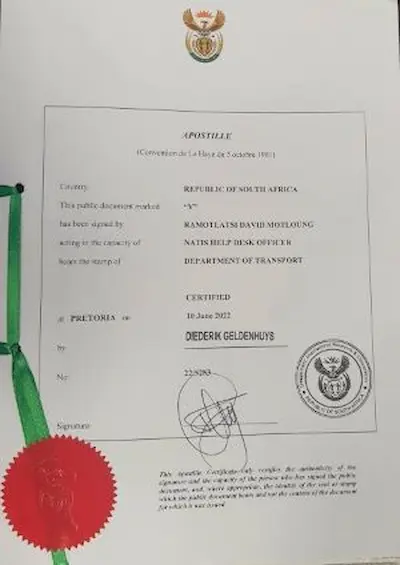
If you need to use a South African document in another country, you may be asked to have it apostilled, authenticated, legalised, or certified for international use. These terms can feel confusing, especially when you are dealing with immigration, visa applications, marriage abroad, employment, study, or legal matters.
In South Africa, official public documents may be legalised by the Department of International Relations and Cooperation, commonly known as DIRCO. DIRCO explains that legalisation confirms the signature and seal on a South African public document so that it can be used outside South Africa. Depending on the destination country, DIRCO may issue either an Apostille Certificate or a Certificate of Authentication.
The key difference is simple:
An apostille is generally used for countries that are part of the Hague Apostille Convention.
An authentication certificate is generally used for countries that are not part of the Hague Apostille Convention.
What Is an Apostille?
An apostille is an official certificate attached to a public document to confirm that the signature, stamp, or seal on the document is genuine.
It does not confirm that the contents of the document are true. Instead, it confirms that the document was issued or signed by a recognised authority.
Apostilles are used between countries that are members of the Hague Apostille Convention. DIRCO notes that South African official public documents intended for use abroad may be affixed, sealed, and signed with an Apostille Certificate when the destination country is a signatory to the Convention.
Common South African documents that may require an apostille include:
- Police Clearance Certificates
- Unabridged Birth Certificates
- Unabridged Marriage Certificates
- Unabridged Death Certificates
- Letters of No Impediment
- Driver’s Licence Confirmation Letters
- Certain academic or notarised documents
What Is Authentication?
Authentication is also a legalisation process, but it is normally used when the destination country is not part of the Hague Apostille Convention.
Instead of an apostille, DIRCO may issue a Certificate of Authentication. This confirms the signature and seal on the South African public document for use in a non-Hague country. DIRCO explains that legalisation may be done either by Apostille Certificate or Certificate of Authentication, depending on the country where the document will be used.
In many non-Hague cases, authentication may also need to be followed by embassy or consular legalisation, depending on the country’s requirements.
Apostille vs Authentication: Main Difference
ApostilleAuthenticationUsed for Hague Apostille Convention countriesUsed for non-Hague countriesUsually completed through DIRCO for public documentsUsually completed through DIRCO and may require embassy legalisationConfirms the document signature, seal, or stampConfirms the document signature, seal, or stampOften used for Europe, UK, Australia, New Zealand, and many other Hague countriesOften used where the destination country has separate legalisation requirementsUsually simpler than embassy legalisationCan involve additional steps after DIRCO
Which One Do You Need?
The correct process depends on the country where your document will be used.
For example, if your South African document is being used in a Hague Convention country, an apostille may be required. If the document is being used in a non-Hague country, authentication and possible embassy legalisation may be required.
DIRCO advises applicants to contact the foreign representative in South Africa of the country where the document will be used to confirm the exact requirements before submitting documents for legalisation.
This is important because immigration offices, embassies, universities, employers, marriage authorities, and legal institutions may each have their own document rules.
Common Reasons South Africans Need Apostille or Authentication
South African documents are often apostilled or authenticated for:
- Immigration applications
- Visa applications
- Marriage abroad
- Foreign employment
- Study abroad
- Citizenship applications
- Family reunification
- Legal matters overseas
- Business or company use abroad
- Driver’s licence conversion
- Police clearance requirements
Documents Commonly Submitted to DIRCO
DIRCO’s legalisation booking information refers to public documents such as civic documents issued by the Department of Home Affairs, academic verification letters, and SAPS Police Clearance Certificates.
Examples include:
- Home Affairs birth, marriage, and death certificates
- SAPS Police Clearance Certificates
- Letters of No Impediment
- Driver’s Licence Confirmation Letters
- SAQA or academic verification documents
- Certain notarised documents after the correct preliminary steps
Can All Documents Be Apostilled?
No. Not every document can go directly to DIRCO for apostille or authentication.
Some documents must first be prepared, verified, notarised, or authenticated by another authority before they can be submitted. For example, certain private documents may need to be notarised first, while some academic documents may require verification before DIRCO can assist.
This is why document preparation matters. Submitting the wrong version, an incomplete document, or a document without the required verification can lead to rejection or delays.
Practical Example
If you are applying for a visa overseas and the foreign authority requests a South African Police Clearance Certificate with an apostille, the general process may look like this:
- Apply for the SAPS Police Clearance Certificate.
- Wait for the certificate to be issued.
- Submit the original certificate for DIRCO apostille or authentication.
- Courier or present the final legalised document to the foreign authority.
If the destination country does not accept apostilles, the document may require authentication and further embassy legalisation.
Apostille vs Notarisation
Apostille and notarisation are not the same.
A notary public may certify, witness, or prepare certain documents. An apostille is an international legalisation certificate confirming the recognised signature, stamp, or seal on a public document or properly prepared notarised document.
In some cases, a document may need to be notarised first before it can continue through the correct legalisation route.
Why the Destination Country Matters
The destination country decides what it will accept.
This means the same South African document may require different handling depending on whether it is being used in:
- Ireland
- United Kingdom
- Australia
- New Zealand
- United Arab Emirates
- Qatar
- China
- Portugal
- Germany
- Canada
- United States
Always confirm the latest requirements with the receiving authority before submitting documents.
How Authentic Documents SA Assists
Authentic Documents SA assists local and international clients with South African document support for use abroad.
Our services include assistance with:
- South African Police Clearance Certificates
- DIRCO Apostille Authentication
- Unabridged Birth Certificates
- Unabridged Marriage Certificates
- Letters of No Impediment
- Driver’s Licence Confirmation Letters
- Retention of South African Citizenship
- Notary and legalisation support
- Courier coordination for local and international clients
We focus on structured guidance, clear communication, secure document handling, and practical support for clients who need South African documents prepared for immigration, travel, legal, employment, study, or marriage purposes abroad.
Frequently Asked Questions
Is apostille the same as authentication?
No. An apostille is generally used for Hague Convention countries. Authentication is generally used for non-Hague countries and may involve further embassy or consular legalisation.
Who issues apostilles in South Africa?
For many South African public documents, apostilles are issued by DIRCO. Certain documents may require other preparation steps before DIRCO can legalise them.
Can I apostille a South African police clearance?
Yes. Once issued, a South African Police Clearance Certificate is commonly submitted for apostille or authentication if it is required for use abroad.
Can I apostille an unabridged birth certificate?
Yes. An original unabridged birth certificate issued by Home Affairs may often be submitted for apostille or authentication, depending on the destination country’s requirements.
Do I need apostille for immigration?
Many immigration authorities request apostilled or authenticated documents. Requirements depend on the country, visa type, and receiving authority.
What happens if my country is not part of the Hague Convention?
If the destination country is not part of the Hague Apostille Convention, your document may require authentication and possibly embassy legalisation instead of an apostille.
Can I use a scanned copy for apostille?
In most cases, original documents are required. Scanned copies are generally not enough unless the document has gone through a specific notarisation or certification process accepted by the relevant authority.
Should I check with the embassy first?
Yes. DIRCO advises applicants to check with the foreign representative of the country where the document will be used to confirm the exact legalisation requirements.
Final Thoughts
The difference between apostille and authentication depends mainly on where your South African document will be used.
If the destination country is part of the Hague Apostille Convention, an apostille is usually required. If the destination country is not part of the Convention, authentication and possible embassy legalisation may be required.
Because each country and authority may have different requirements, it is important to confirm the correct process before submitting documents.
Call to Action
Need assistance with apostille, authentication, or South African document preparation for use abroad?
Contact Authentic Documents SA for professional document guidance and structured support with South African police clearances, unabridged certificates, DIRCO apostille services, authentication, and related international document requirements.