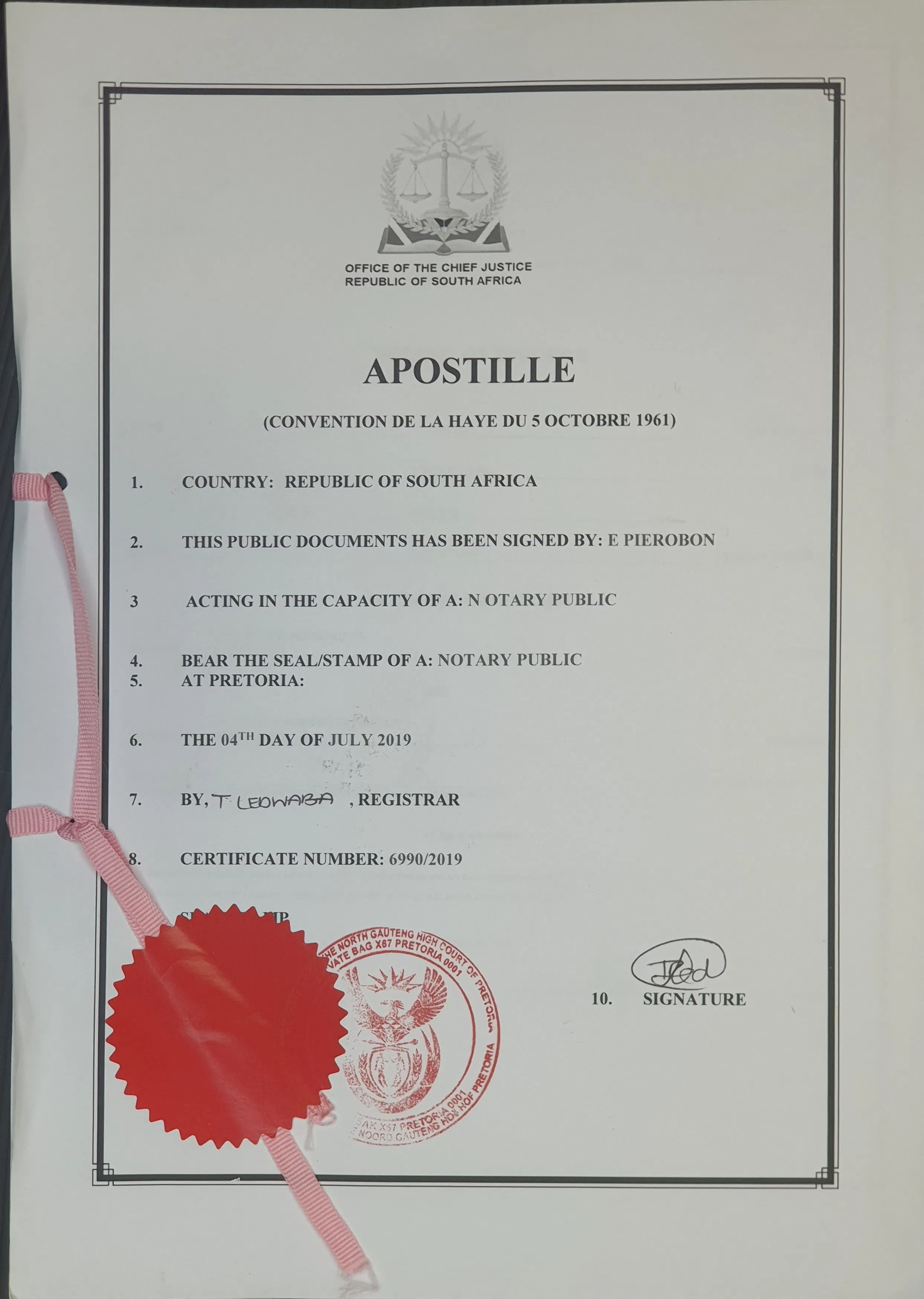
What Is the DIRCO Apostille Service and How Does It Work?
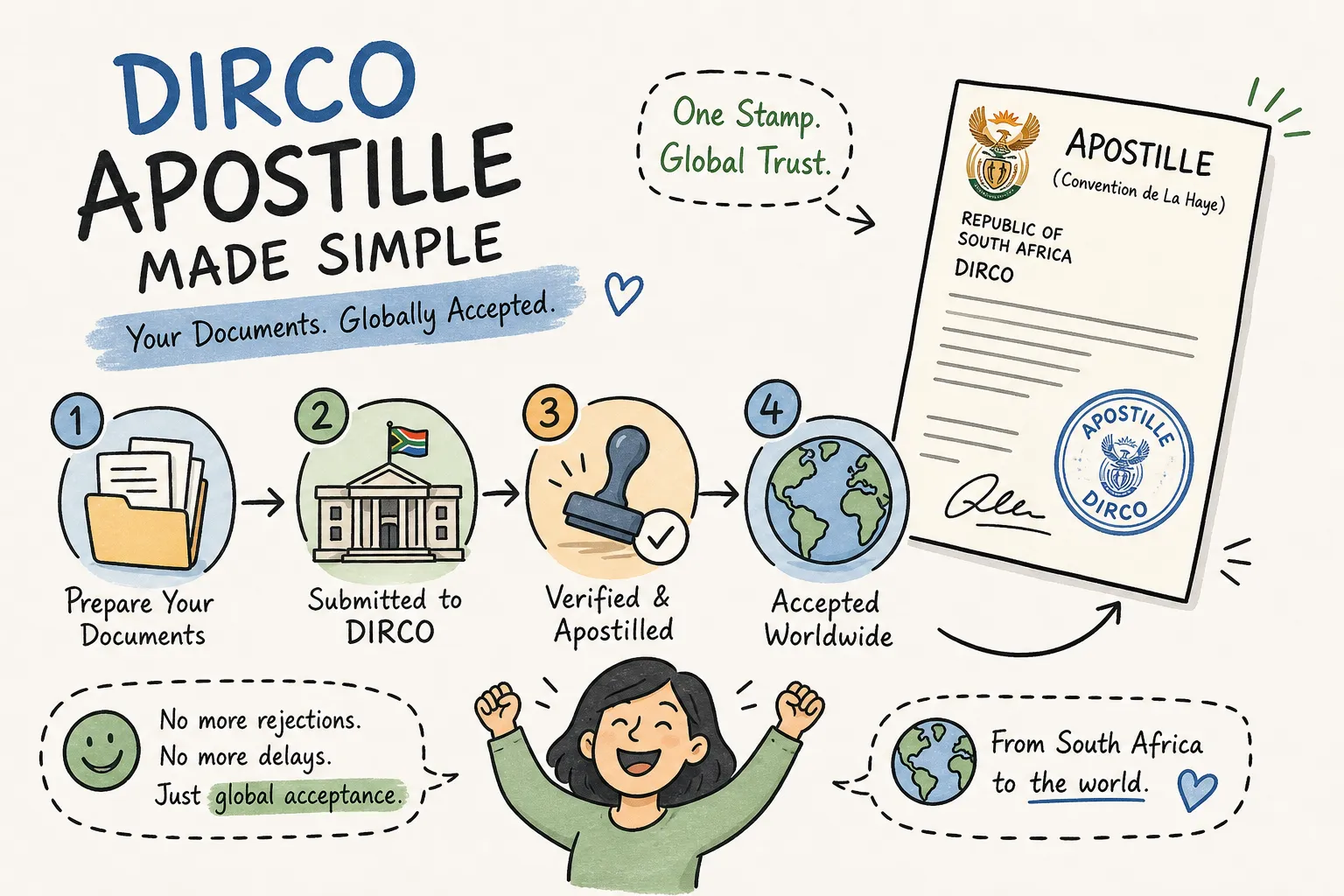
You need a South African document recognized in the United States, and someone tells you it needs an apostille from DIRCO. If you're sitting in New York, Houston, or Los Angeles, that answer raises more questions than it answers. What is DIRCO? Where is the office? How do you get your documents there from thousands of miles away? Understanding the DIRCO apostille service before you send a single document is the only way to avoid a costly, weeks-long restart. This guide covers exactly how it works, what qualifies, current processing times, and how South Africans in the US can access it remotely.
The Department of International Relations and Cooperation is South Africa's official gateway for international document recognition. Its legalisation section in Pretoria handles apostille authentication for government-issued South African documents, and the process has specific rules that catch people off guard, especially applicants managing everything remotely. South Africans in the US often work with specialist third-party services to handle DIRCO submissions on their behalf, precisely because a single preparation error can reset the clock by weeks.
This guide is for South Africans living abroad, green card applicants, people marrying overseas, and anyone who needs an officially authenticated South African document and wants to understand the process before committing time and money to it.
What the DIRCO apostille service is and why your documents need it
South Africa is a signatory to the Hague Apostille Convention of 1961, which created a standardized system for authenticating public documents across member countries. An apostille does not verify the content of a document; it authenticates the signature, seal, or stamp of the issuing authority so that the receiving country recognizes the document as genuine. DIRCO is South Africa's designated competent authority for government-issued public documents.
If your destination country is a Hague Convention signatory, an apostille is the final step, and it's sufficient on its own. The United States is a Hague Convention member, so South African documents apostilled by DIRCO are directly recognized by US authorities, including USCIS. If your destination is not a Convention country, China, UAE, and Saudi Arabia are common examples, DIRCO issues a Certificate of Authentication instead, and you must then take that to the destination country's embassy for a final legalisation step. Knowing which applies to your situation before you submit saves weeks.
No other South African authority replaces DIRCO for government-issued documents. For non-government documents (notarized private contracts or powers of attorney, for example), the High Court may issue an apostille directly without DIRCO involvement. That distinction matters because it affects which documents need pre-verification, which go straight to DIRCO, and which bypass DIRCO entirely.
Which documents the DIRCO apostille process will and won't accept
Government-issued documents go directly to DIRCO with no prior notarization required. These include unabridged birth, marriage, and death certificates; SAPS police clearance certificates; Letters of No Impediment; driver's licence confirmation letters; citizenship and renunciation letters; divorce decrees; and adoption papers. They must be originals, unabridged, valid, undamaged, and not laminated. One rule that trips people up regularly: certified copies of birth, marriage, and death certificates have not been accepted since September 2024, per DIRCO's updated acceptance policy. You need the original issued document.
Some documents require a pre-verification step before DIRCO will process them. Academic qualifications from South African public universities need SAQA verification first. Matric certificates need Umalusi verification. Medical practice certificates require HPCSA authentication. DIRCO apostilles the verification letter from these bodies, not the original qualification itself.
Non-government private documents, powers of attorney, private academic transcripts, company documents, must be notarized by a Notary Public and then authenticated by the High Court. For that category, the High Court may issue the apostille directly, removing the need for DIRCO altogether.
DIRCO rejects photocopies, scans, abridged certificates, laminated documents, and anything damaged or illegible. Submitting a government document that has been notarized is also a rejection trigger. DIRCO authenticates the government official's signature directly, and notarization interferes with that chain of authority. This is one of the most common errors applicants make when preparing documents without expert guidance.
How the DIRCO booking system and submission process works
DIRCO's legalisation section operates from a single office at the OR Tambo Building, 460 Soutpansberg Road, Rietondale, Pretoria. The online booking system opens daily at 08:30, except Wednesdays, and assigns appointment slots to individual applicants. At your appointment, you present your confirmation email and ID; access is granted 30 minutes before your slot, and a reference number is issued at the window. Collection requires no separate booking.
Walk-ins are accepted only at the OR Tambo Building, capped at five per day, and no walk-ins are admitted after 11:00 or on Wednesdays. This matters because from 1 September 2026, walk-in access is being fully discontinued. After that date, only clients with confirmed bookings will be assisted, making the online system the only option for in-person submissions.
Agents and third-party services cannot use the online booking system at all. Per DIRCO's guidance, they are required to submit via courier exclusively, sending documents to DIRCO's Legalisation Section at the address above. Use a trackable courier like DHL or The Courier Guy; DIRCO explicitly advises against standard postal services for international submissions. Your package must include a cover letter stating the destination country and your contact details, so DIRCO can notify you when processing is complete.
Submitting the DIRCO apostille service remotely from the US
DIRCO's official Legalisation Section operates only in Pretoria. While third-party agents and High Court offices exist in other cities, including Cape Town and Johannesburg, to assist with pre-verification steps or High Court authentication, the DIRCO apostille itself must go through Pretoria. There is no DIRCO office in the United States. For South Africans in the US, this means you cannot book an in-person appointment, drop documents off personally, or follow up at the counter. The only official routes available are the courier submission path and working through a registered agent who is physically in South Africa.
Sending original documents internationally via courier carries real risk. Documents lost in transit, rejected at DIRCO for a preparation error, or delayed because the wrong document version was sent are all common problems. An abridged birth certificate instead of an unabridged one, or a police clearance older than six months, will be turned away and the clock starts over. For immigration deadlines or visa applications, a single rejection can cost six to eight weeks you may not have.
There is also a collection problem that often gets overlooked. When DIRCO finishes processing a courier submission, documents are not automatically returned. You need a representative in South Africa with the right paperwork to collect, or a courier arrangement set up in advance. Managing this from a US address, without knowing South Africa's current requirements, is where most remote applicants run into serious delays.
Current fees and processing times for the DIRCO apostille service
The DIRCO apostille service itself is completely free. No official fee exists, and no expedited payment option is available through DIRCO. DIRCO's official guidelines state same-day turnaround for five or fewer documents submitted in person, one to two weeks for registered service providers, and three to four weeks via courier. The reality in 2026 is different: backlogs have pushed standard turnaround to 30 to 40 working days (six to eight weeks) for many applicants. Note that registered service providers can sometimes achieve faster results through direct submission channels, but this varies and backlogs have affected agents as well during peak periods.
Third-party services charge for document review, submission handling, and courier logistics. Fees range from approximately R875 to R2,500 per document depending on the service level. Some agents advertise an express route through the High Court, which takes one to three working days, but this applies only to notarized non-government documents. For government originals like birth certificates or police clearance certificates, no reliable express route exists outside DIRCO's queue. Anyone promising fast-tracked DIRCO apostilles for government documents is not being accurate about how the process works.
When using an end-to-end apostille service makes more sense than going it alone
To manage the DIRCO process correctly from the US, you need someone in South Africa who knows the current requirements, checks your documents before submission, physically couriers them to DIRCO, tracks the application with updates, and returns authenticated documents to your US address. This is not something a generic courier company provides. It requires specific knowledge of South African government document workflows and current DIRCO acceptance criteria.
Authentic Documents SA manages the entire DIRCO apostille workflow on your behalf. That covers document compliance review before submission, checking originals, confirming document type, identifying any pre-verification required, physical submission to DIRCO's legalisation section in Pretoria, application tracking with progress updates, and international courier delivery of the apostilled document to your US address. You don't need to understand the difference between an apostille and a Certificate of Authentication, which certificate version DIRCO currently accepts, or how the booking system works. That's handled.
The service is particularly valuable for South Africans applying for US green cards or permanent residency (where USCIS requires apostille-authenticated police clearances or civil documents), expats needing documents for employment background checks, dual citizenship applicants, and anyone working against a tight immigration or legal deadline. It also suits people who have already had a DIRCO submission rejected and need a clean, correctly prepared resubmission without additional delays.
DIRCO's process costs nothing in official fees, but the hidden costs are real: six to eight weeks of processing time, the risk of rejection, the complexity of collection, and the challenge of managing it across twelve time zones. A professional service that charges a transparent fee in exchange for a correctly prepared, submitted, and delivered document is often the faster and less costly outcome when you factor in the price of errors, rejections, and extended wait times.
What to do next
Before you submit anything to DIRCO, confirm three things: whether your document goes straight to DIRCO or requires a pre-verification step first, whether you have the original unabridged version (not a certified copy or abridged version), and whether the six-to-eight-week current backlog fits your timeline. If all three work in your favor, the courier route is manageable. If any one of them is a problem, getting it wrong delays everything.
South Africans in the US dealing with immigration deadlines, visa applications, or legal proceedings rarely have the margin for a rejected submission and a six-week restart. The DIRCO apostille service rewards preparation and current knowledge of its requirements. If you want the dirco apostille service handled correctly without navigating it yourself, Authentic Documents SA manages the entire process on your behalf, from document review through to delivery at your US address. Contact Authentic Documents SA to start the process.
How Authentic Documents SA Assists
Authentic Documents SA assists clients in South Africa and internationally with document preparation for overseas use.
Our services include:
- DIRCO Apostille Services
- Authentication Services
- Police Clearance Certificates
- Unabridged Birth Certificates
- Unabridged Marriage Certificates
- Letters of No Impediment
- Driver's Licence Confirmation Letters
- Notary and legalisation support
- Courier coordination for local and international clients
We provide structured guidance, clear communication, and professional assistance throughout the document preparation process.
Final Thoughts
The DIRCO apostille process is an important step for many South Africans preparing documents for international use.
Whether you are immigrating, getting married overseas, applying for employment, studying abroad, or handling legal matters, ensuring your documents are properly prepared and legalised can help prevent unnecessary delays.
Understanding the difference between apostille and authentication, confirming the destination country's requirements, and preparing the correct original documents will make the process smoother and more efficient.