How Long Does a Police Clearance Certificate Take in South Africa? (2026 Guide)
If you have a US visa interview scheduled, a USCIS submission deadline closing in, or a job offer that won't wait, you're probably asking the same question most South Africans abroad ask first: how long does a police clearance certificate take in South Africa? The honest 2026 answer isn't a single number. It depends on how you apply, where your fingerprints are captured, and whether you also need apostille authentication before the document carries legal weight abroad. This guide breaks down the realistic timelines for every common scenario, explains what causes delays, and gives you a planning framework built around real deadlines.
At Authentic Documents SA, South Africans in the US raise this question more than any other. You can't walk into a SAPS office from Houston or Los Angeles, and you can't afford to guess at timelines. The question isn't just how long it takes, it's how long it takes given your specific situation.
What SAPS officially promises, and what applicants actually experience
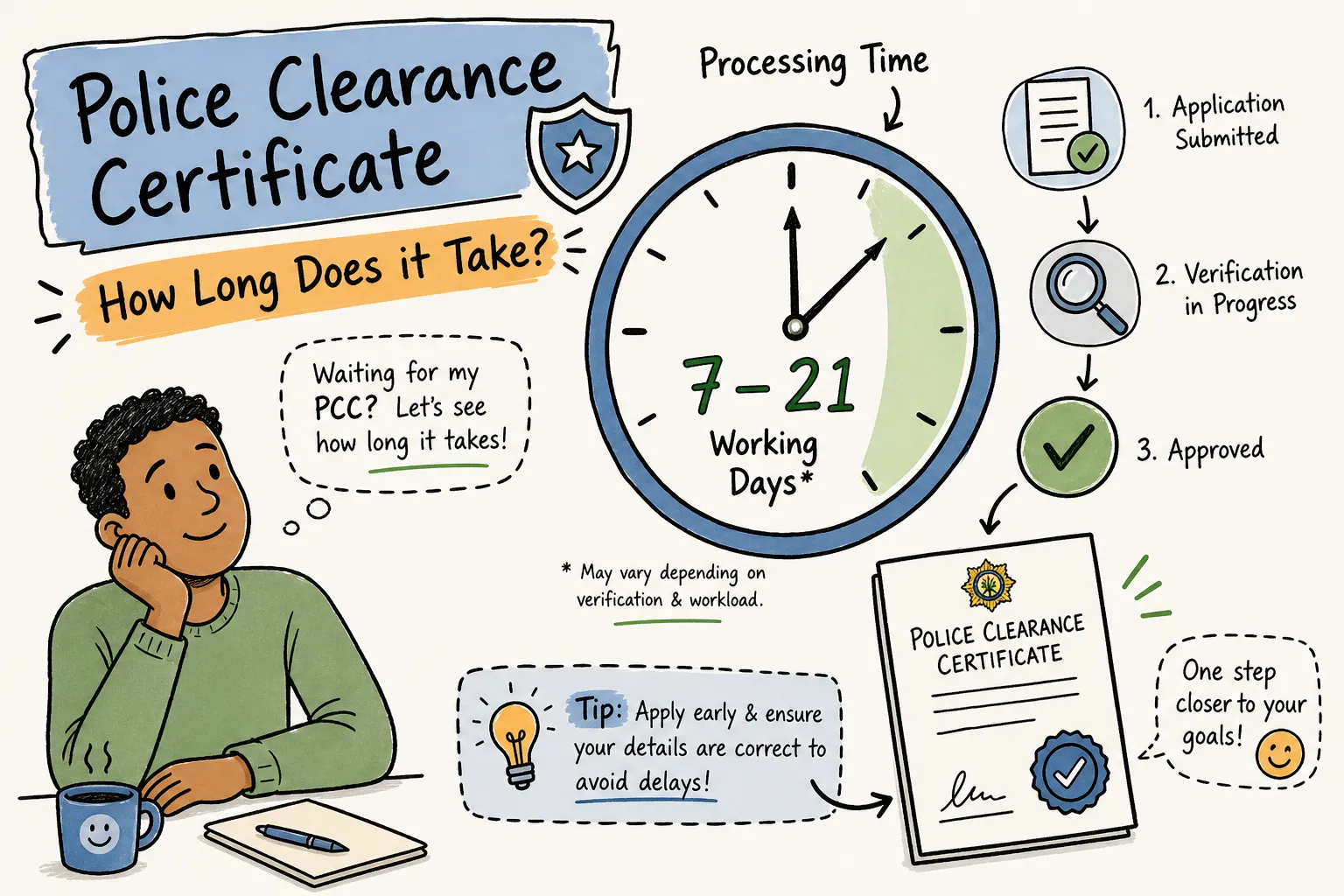
SAPS officially targets 14 working days from receipt of a complete application at the Criminal Record Centre (CRC), according to SAPS CRC guidance. That figure appears straightforward, but it carries a critical qualifier: the 14-working-day clock starts only once the CRC physically receives your file. It does not start when you submit at your local police station. Station-to-CRC forwarding adds time that isn't counted in the official target at all.
The gap between the official figure and real-world outcomes is significant. For most straightforward applications in 2026, experienced practitioners and applicants consistently report 6 to 8 weeks as the practical baseline. If the CRC is carrying a backlog, or if your fingerprints trigger a quality query, timelines can stretch to 3 to 6 months, with some conservative estimates reaching 8 to 20 weeks during heavy-load periods. That variance is wide, and it's exactly why early planning is non-negotiable for anyone with a fixed immigration or employment deadline.
How your application route changes the wait
The channel you use to submit your application affects both convenience and total turnaround time. For applicants inside South Africa, a direct SAPS station application is the most straightforward route. In practice, real turnaround for a clean, complete application, once station forwarding time is factored in, typically runs 4 to 8 weeks, with the lower end reflecting smooth submissions and the higher end accounting for forwarding delays.
VFS Global is the most commonly used third-party channel, and their published guideline for police clearance processing is 28 business days, roughly 5 to 6 weeks. This is an important distinction: VFS does not jump the SAPS queue. They change the submission channel, not the underlying CRC processing speed. When you include forwarding time and return courier delivery, total VFS route turnaround commonly runs 6 to 10 weeks from appointment to certificate in hand.
For South Africans based in the US, two realistic paths exist. You can attend a VFS appointment at a South African consulate-linked centre in a city like New York or Los Angeles, or you can engage a South African document assistance service to submit on your behalf locally in South Africa. Either route adds courier and forwarding layers that push total turnaround beyond the standard local estimate. Neither route bypasses the CRC. What changes is the support structure around the submission.
The real reasons your PCC gets delayed
Most delays trace back to a handful of causes, and most of them are avoidable with the right preparation.
Fingerprint quality is one of the biggest controllable risks. Ink fingerprint cards carry a significantly higher rejection risk than live-scan submissions. Smudged, faint, or incomplete impressions are returned to the applicant for recapture, adding weeks to your timeline.
Live-scan at an authorised provider produces cleaner, electronically captured records that reach the CRC faster and with far fewer quality queries. If you have a choice between ink and live-scan, live-scan is strongly preferable. For overseas applicants who must use ink on the SAPS 91(a) form, investing time in finding a provider who takes high-quality inked sets pays dividends later.
The second cause is missing or incorrect documentation. An incomplete application sits at the CRC without being processed, and the CRC does not proactively notify you when something is wrong. This is the most damaging scenario for applicants with fixed deadlines: weeks pass, nothing arrives, and there is no automatic alert that your application is stalled. Correct, complete documentation from the outset is the only way to avoid this outcome. The third cause, CRC backlogs, is outside anyone's control, which makes it all the more important that everything else in your application is right the first time.
Adding apostille authentication to your timeline
For many US immigration submissions, USCIS applications, and employer background verification processes, a raw SAPS police clearance certificate will need DIRCO apostille authentication to be accepted as a legally recognised document abroad. Requirements vary by receiving agency, so confirm what your specific institution requires, but if you're submitting for US immigration purposes, apostille is generally expected.
The Department of International Relations and Cooperation (DIRCO) handles apostille authentication for South African documents. Under normal conditions, with an in-person or pre-booked appointment, same-day or 1 to 2 working day turnaround is possible for small batches. For private courier submissions, the most relevant channel for overseas applicants and their local representatives, allow 3 to 4 weeks as a realistic baseline. During backlog periods, service providers report waits of 6 to 8 weeks for apostille alone. The apostille process is sequential: it can only begin once the original SAPS certificate is in hand.
Building these stages together, a South Africa-based applicant targeting a US immigration use case should plan a realistic total of 10 to 14 weeks. This breaks down as follows: PCC processing (6 to 8 weeks), plus apostille authentication (3 to 4 weeks under normal conditions), plus international courier delivery (3 to 7 business days). If any stage encounters a delay, add a conservative buffer of 4 to 8 weeks. Most immigration attorneys and experienced practitioners recommend starting the process at least 3 months before your submission deadline. For USCIS applications specifically, the safer planning buffer is 4 to 6 months, given how costly a missed deadline can be.
How to plan around a US visa or employment deadline
Start with your hard deadline, your USCIS submission date, visa interview, or employer background check cut-off. Work back at least 14 weeks as your minimum buffer, then add another 2 to 4 weeks to account for any fingerprint, documentation, or apostille query. If that calculation puts your start date in the past, you need a monitoring-first approach that actively tracks your application's progress rather than waiting for it to arrive.
The biggest risk in a PCC process isn't normal processing time. It's the silent stall: a fingerprint query, a missing detail, or a misfiled application that sits unresolved because no one is watching it. This is where working with a structured document assistance service genuinely changes the outcome. The team at Authentic Documents SA monitors active applications and follows up directly with the CRC when expected progress stalls, helping to flag issues before they quietly compound into months of lost time. For South Africans in the US with real immigration or employment deadlines, that active oversight is often the difference between meeting a deadline and missing it entirely.
One timing consideration specific to USCIS submissions: don't request your certificate so far in advance that it expires before your interview. Department of State guidance generally treats police certificates as valid for two years from the date of issue, but the certificate must remain valid through the interview stage. Build your timeline so the certificate arrives within a reasonable window before your deadline, not months earlier when the validity period begins to erode.
Spotting a legitimate expedited service vs a scam
The police clearance space attracts providers who make promises that no private company can keep. Knowing what a legitimate service actually does, and doesn't do, keeps your deadline, and your money, intact.
A legitimate document assistance service does specific, verifiable things. It prepares your application correctly before submission, reducing the chance of rejection. It captures fingerprints through the right channel, submits to the correct CRC address, and follows up directly when timelines stall. It coordinates apostille with DIRCO and delivers authenticated documents to your address worldwide. What it cannot do is bypass SAPS processing or jump the CRC queue, and it will never claim otherwise.
Watch for these warning signs before engaging any provider:
- Promises of a completed, apostilled police clearance in under two weeks.
- No clear separation between the service fee and official government fees.
- Vague claims of "special access" to SAPS or DIRCO systems.
- Pressure to pay the full amount upfront with no documented process or progress updates.
- No verifiable physical address, no client references, and no transparent workflow.
If a provider's quoted timeline contradicts published SAPS and DIRCO processing windows, treat it as a scam. There is no private route that bypasses the CRC. The value a legitimate service provides is preparation, submission, follow-up, and coordination, not magical access to a faster queue.
Start earlier than you think you need to
So, how long does a police clearance certificate take in South Africa in 2026? For a straightforward in-country application, realistic processing runs 6 to 8 weeks. For an apostilled document delivered to a US address, plan closer to 10 to 14 weeks, and if you're submitting for USCIS purposes, a conservative buffer of 4 to 6 months is the safer call. The variables that stretch timelines, fingerprint quality, silent stalls, backlog periods, and DIRCO queues, are manageable when you plan early and have someone actively monitoring your case.
If you are based in the US and cannot afford a delay, the smartest move is to start now. Authentic Documents SA manages the full process, from fingerprint coordination and CRC submission through to DIRCO apostille and worldwide courier delivery, with active progress monitoring at every stage. Reach out before your timeline becomes a problem. The earlier you start, the more options you have.
Why Use a Professional Assistance Service?
Many applicants prefer expert help because it can reduce delays, confusion, and repeated follow-ups.
Authentic Documents SA assists clients locally and internationally with document applications and secure courier options.
Need Help?
If you need assistance with a Police Clearance Certificate in South Africa, contact Authentic Documents SA for professional support.
https://www.authenticdocumentssa.co.za