The 2026 Complete Guide to South African Police Clearance for Immigration
You're sitting in New York or Houston. Your immigration attorney has just called to say your application is incomplete without a South African police clearance certificate, and SAPS doesn't have a walk-in desk in your city. It's a situation we frequently encounter at Authentic Documents SA, which is precisely why this police clearance certificate for immigration visa applications South Africa 2026 guide exists: to walk you through every step of the process, whether you're down the road from Pretoria or halfway across the world.
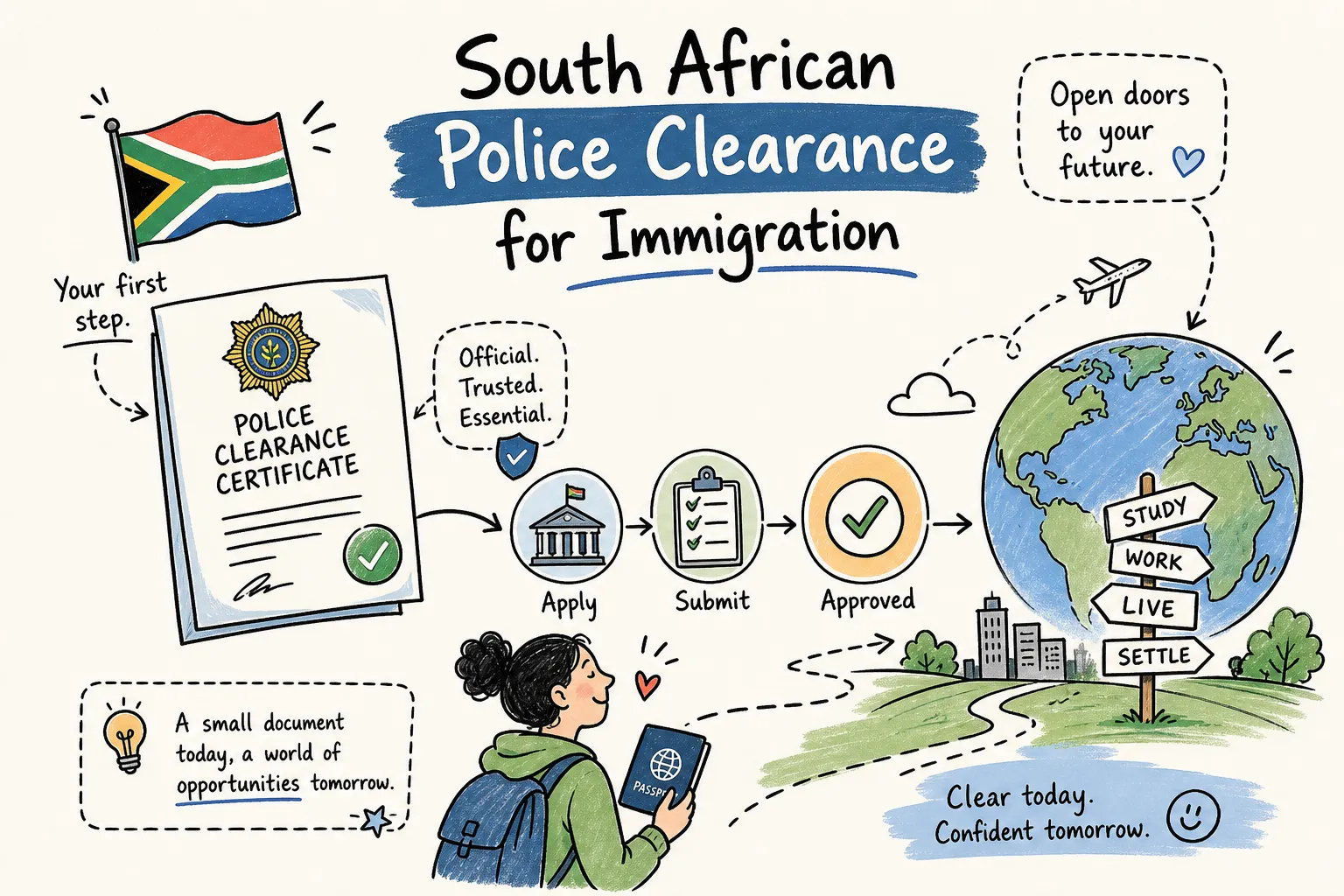
This guide covers the full process, from gathering the right documents and getting your fingerprints taken abroad, to submitting your application to the SAPS Criminal Record Centre, understanding realistic processing times in 2026, and getting your certificate apostilled at DIRCO for use in the US, UK, or any Hague Convention country.
What you need to gather before you apply for a police clearance certificate
The SAPS 91(a) is the official fingerprint enquiry form that underpins every police clearance certificate application. You can obtain it directly from SAPS, download it from the SAPS website, or request it through a specialist document assistance service. Submitting the wrong form, or a version that isn't properly completed, is one of the most common reasons applications stall at the Criminal Record Centre before they're even reviewed.
Your document checklist must include a certified copy of your South African ID or valid passport (bring the original if you're applying in person at a police station), and proof of payment of the prescribed SAPS fee. The current fee is reported at R190 per application, confirm this directly with SAPS before making payment, as different sources have quoted varying amounts and fees can change. A cover letter stating the intended purpose of the certificate (immigration or visa application) is strongly recommended, even where it isn't explicitly required.
If your surname has changed through marriage or any other legal process, this needs attention before you submit. SAPS requires documentary proof of the name change, such as a marriage certificate or a court order, attached to your application. Without this, the certificate may reflect incorrect information or be returned entirely. Getting this right on the first attempt is non-negotiable, particularly when you're applying from abroad.
Getting your fingerprints taken when you're not in South Africa
Applicants living outside South Africa have three realistic routes for fingerprinting. You can visit a local police station in your country of residence, attend the nearest South African embassy or consulate, or use a private fingerprinting service authorised in your jurisdiction. SAPS explicitly states that applicants abroad may apply at any police station in that country or at a South African Embassy. In the United States, the South African Consulate General in New York offers fingerprinting for police clearance applications, check their current consular services page for appointment requirements and operating hours before you visit.
The question of which fingerprint form to use trips up more applicants than it should. SAPS accepts either the official SAPS 91(a) form or the official fingerprint form used in the country where the prints are taken. Before you leave the fingerprinting appointment, ask the officer directly whether the completed prints will be acceptable for submission to the SAPS Criminal Record Centre in Pretoria. An unclear answer at this stage is worth clarifying before you courier anything.
This is the practical detail that catches many applicants off guard: SAPS requires original physical fingerprint forms and supporting documents. Scanned copies are not accepted. Digital submissions are not an option. Everything must be physically couriered to Pretoria, which adds both cost and transit time to the overall process. Budget for this from the outset, and use a tracked courier service so you have a clear paper trail.
How to submit your police clearance certificate application from anywhere in the world
You have two submission routes to the Criminal Record Centre. Submissions can be posted to SAPS CRC at Private Bag X308, Pretoria, 0001, or couriered directly to the CRC Client Service Centre on the 1st Floor of Bothongo Plaza West, 271 Francis Baard Street, Pretoria. Submissions from abroad go directly to Pretoria; they do not pass through a South African consulate or embassy.
Your submission package must include the completed SAPS 91(a) fingerprint form, a certified copy of your ID or passport, proof of payment, any supporting name-change documents, and a cover letter stating the intended use of the certificate. Missing a single item delays the entire process. There is no partial processing and no facility to submit missing items after the fact.
There is one SAPS policy that every applicant abroad must know before they post anything: applications received from abroad will not be returned to the applicant. That means if your submission is incomplete or incorrect, it won't come back to you for correction. It simply won't be processed. For expats who cannot easily resubmit, this makes accuracy on the first attempt the only acceptable standard.
Realistic processing times and what causes delays in 2026
The official SAPS turnaround is 14 to 15 working days from the date a complete application reaches the Criminal Record Centre. In practice, 2026 feedback from applicants and service providers consistently places standard processing at two to three weeks for clean applications. During backlog periods, timelines stretch to six to eight weeks or longer, and for applicants managing international couriering and embassy fingerprinting on top of SAPS processing, total wait times can reach three to six months.
The main causes of delay are predictable and largely avoidable. Incomplete application packets are returned without being processed. High application volumes at the CRC create queues. Public holidays in South Africa extend timelines that applicants abroad often don't account for. Smudged, partial, or incorrectly formatted fingerprints are a particularly frustrating cause of rejection because SAPS doesn't always communicate the specific reason back to the applicant clearly or promptly.
No private agency can override SAPS's internal processing queue, and any service claiming otherwise is overpromising. What a specialist service genuinely does is reduce the preparation and submission lag. Documents are checked before submission. Tracked couriers are used. Applications are followed up directly. Agency-assisted timelines in 2026 are commonly quoted at five to seven working days for urgent cases, but this reflects the agency's end of the process. The SAPS queue itself is what it is.
Apostille and legalisation: making your certificate valid abroad
If the country requiring your police clearance is a signatory to the Hague Apostille Convention, you need an apostille from DIRCO. The USA, the UK, and most Schengen countries qualify, you can verify any destination country's membership on the Hague Conference on Private International Law website. If the destination country is not a Hague member, you need full legalisation through DIRCO followed by attestation at the relevant embassy. For most immigration visa applications in the US, apostille is the correct and sufficient route.
The DIRCO process works as follows. Once you have your original SAPS police clearance certificate, you submit it to the DIRCO Legalisation Section, located at the OR Tambo Building, 460 Soutpansberg Road, Rietondale, Pretoria, 0084. DIRCO apostilles the original document, not a certified copy. Include a cover letter stating the country where the document will be used, as this determines whether DIRCO issues an apostille or a standard authentication certificate. You can deliver in person or send by courier.
The six-month validity rule is the timing trap that catches the most applicants. DIRCO requires that original police clearance certificates submitted for legalisation must not be older than six months. For immigration applicants, this means the SAPS application, the apostille at DIRCO, and the submission to immigration authorities all need to happen within a specific window. If you let the certificate age past six months before submitting to DIRCO, SAPS must re-issue it, and the entire cycle starts again. Confirm the current requirements directly with DIRCO before submission, as administrative guidelines can be updated.
Common rejection reasons and why many expats hand this to a specialist
The errors that send applications back to square one follow a consistent pattern. Uncertified ID copies. Smudged or incomplete fingerprints. Missing proof of a name change. The wrong fingerprint form. Incorrect fee payment. Physical documents not submitted because the applicant assumed a scan would be acceptable. Each of these errors means restarting the process, and for an expat managing a firm immigration deadline, that restart can have serious consequences.
This is where a service like Authentic Documents SA earns its place in the process. Rather than navigating SAPS, DIRCO, embassy fingerprinting appointments, and international couriers independently, a specialist manages every step: advising on the correct forms, coordinating fingerprinting, and checking documents before submission. The service then handles couriering to Pretoria, tracks the application, manages apostille at DIRCO, and delivers the completed certificate to your door, wherever in the world that is. Many clients find that working with a specialist is cost-effective compared with the time lost and the risk of starting over after a failed application.
The clients who benefit most from end-to-end case management are those who can't afford to absorb delays. South Africans in the US or UK on skilled visas with a strict renewal window. Green card applicants whose USCIS submission deadline is fixed. Anyone who has already had an application returned once and can't risk a second failure. The combination of process knowledge, direct submission access, and worldwide courier delivery is the specific gap that Authentic Documents SA was built to fill, and it's what separates a managed outcome from an uncertain one.
Getting your police clearance certificate for immigration right the first time
Obtaining a police clearance certificate for immigration visa applications from outside South Africa is manageable when the steps are followed in the right order: the correct form, fingerprints taken on an acceptable card, a complete document pack, a couriered submission to Pretoria, and apostille at DIRCO timed to your visa submission window. Each step is clear when you know what you're looking for.
The honest caveat is that the process spans multiple government departments, each with its own requirements and timelines, and one missing document restarts the clock entirely. For applicants managing a tight deadline or recovering from a previous failed submission, that level of uncertainty carries real risk.
If you'd rather not navigate SAPS, DIRCO, and international couriers on your own, contact Authentic Documents SA for a consultation or quote. The team manages the entire process remotely, from your first fingerprint appointment to the apostille-stamped certificate at your door, so you can focus on your immigration application rather than the paperwork behind it. For personalised guidance on your police clearance certificate for immigration visa applications in South Africa, get in touch today.
Why Use a Professional Assistance Service?
Many applicants prefer expert help because it can reduce delays, confusion, and repeated follow-ups.
Authentic Documents SA assists clients locally and internationally with document applications and secure courier options.
Police clearance certificate South Africa
Need Help?
If you need assistance with a Police Clearance Certificate in South Africa, contact Authentic Documents SA for professional support.
https://www.authenticdocumentssa.co.za