Your 2026 Guide to Dual Citizenship & SA Documents for Immigration
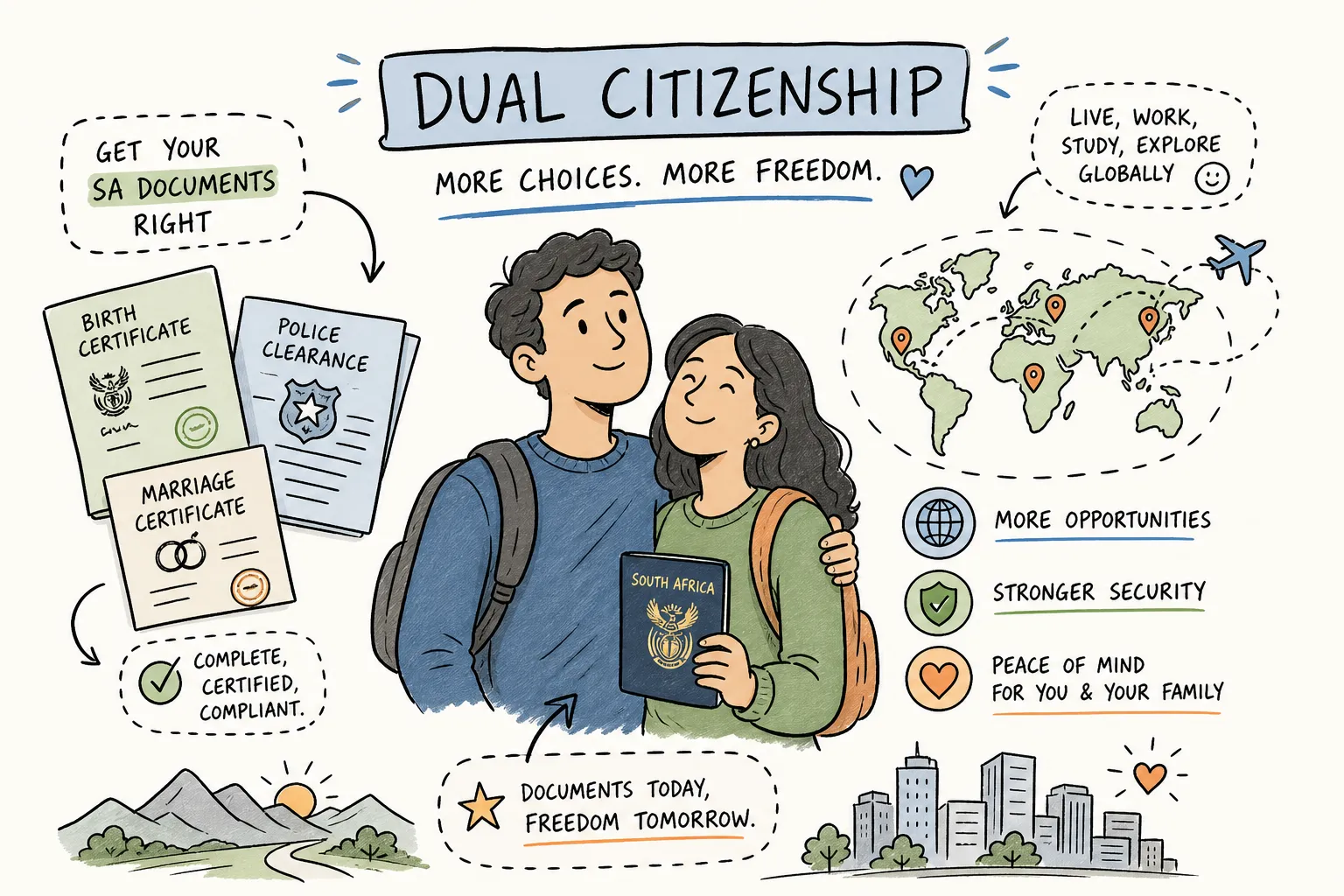
South Africans preparing to emigrate in 2026 are dealing with two overlapping bureaucratic challenges simultaneously: confirming their citizenship status in the wake of a landmark 2025 Constitutional Court ruling, and assembling a set of authenticated South African documents that foreign immigration authorities will actually accept. Most people don't realise these two processes involve different government departments, different timelines, and entirely different rules. Getting either wrong doesn't just cause frustration, it can stall a visa application for months.
This guide maps both processes in one place. It covers what changed legally in 2025, which documents you need and how to get them correctly certified or apostilled, the travel rules that apply to dual nationals, and what a realistic timeline looks like. For South Africans based abroad, particularly in the United States, coordinating everything across multiple government departments from a different time zone is where applications most commonly run into trouble. Authentic Documents SA offers specialist remote case management for exactly this scenario.
What the 2025 Constitutional Court Ruling Actually Changed About Your Citizenship
The automatic-loss rule that no longer applies
Before the May 2025 ruling, South Africans who acquired another nationality without prior written permission from the Minister of Home Affairs automatically lost their South African citizenship. The Constitutional Court struck down Section 6(1)(a) of the Citizenship Act as unconstitutional. The ruling declares the section invalid from its promulgation on 6 October 1995, meaning it never had valid force from that date. Any South African who lost citizenship under this provision is legally deemed not to have lost it.
The practical implications are considerable. If you naturalised as an American, British, Australian, or any other national between 1995 and May 2025 without first applying for retention, you very likely did not lose your South African citizenship. The court's retrospective application covers a 30-year window, from 1995 to May 2025, and may affect a substantial number of South Africans living abroad, though no official quantification has been published to date.
What this means for people who naturalised before May 2025
The legal position is clear, but the administrative reality is messier. Home Affairs records may not yet reflect your reinstated status, and some South African missions abroad continue to process retention applications as part of their administrative workflow. According to publicly available Home Affairs guidance, dual citizenship is now treated as permitted subject to compliance with South African law, though you may still need to engage formally with DIRCO or Home Affairs to confirm your status in writing. If you are planning to travel on a South African passport or apply for a South African document, confirm your status before beginning any application process.
When a Formal Retention Application Is Still Required in 2026
Forms DHA-1664 and DHA-529: what they ask and what trips people up
Even with the court ruling, retention forms are still used administratively for specific situations, and DIRCO missions in the US continue to process them. The two core forms are DHA-1664 (the application to retain citizenship) and DHA-529 (the sworn declaration of intent). Both must be completed in black ink and block letters, with every single question answered in full. "N/A" is not accepted as an answer on any field, and incomplete forms are the most common reason applications are returned without processing.
On the DHA-529, pay particular attention to Parts C and D, which require both parents' details, including their South African ID numbers. Part E must be signed. Based on requirements published by the South African Embassy in Washington, D.C., the Washington mission requires a processing fee (payable by money order), a copy of your South African passport, a copy of your US Permanent Residence Card, and a notarised affidavit confirming you have not yet taken up US citizenship. Fee amounts and supporting-document requirements do change, so always verify the current checklist directly with the Washington mission before submitting anything by mail.
Supporting documents that complete the submission
Beyond the two forms, most retention submissions require a certified copy of a valid South African passport (not the original), valid contact details including a physical address and email address, and a "non-acquisition letter" from the relevant foreign authority proving foreign citizenship has not yet been granted. Where applicable, you will also need an unabridged birth certificate, a marriage certificate, and proof of any previously issued permanent residence permit. Because requirements vary by mission, always confirm the exact checklist with the specific DIRCO mission handling your case before posting anything.
The SA Documents Foreign Immigration Authorities Ask for in 2026
Police clearance, birth records and marriage certificates
Foreign immigration authorities are consistent in what they request from South African applicants. The South African Police Service (SAPS) police clearance certificate is almost universally required for immigration, permanent residency, and long-stay visa applications. It must be an original, photocopies are not accepted. Validity periods vary by destination authority: some receiving countries require certificates issued within six months, while others apply different windows, so check the specific requirements of the country and authority you are applying to. An unabridged birth certificate is required to prove South African birth and parentage, making it essential for citizenship-by-descent applications, green card processing, and family-based immigration categories. Where relevant, a marriage certificate and a certified copy of your South African identity document complete the standard package.
USCIS, for example, requires a foreign police clearance from every country where an applicant has lived for six months or more after the age of 16, and apostille-authenticated civil documents are standard requirements in South African green card and permanent residency applications. These are submission requirements, not optional extras, and if they are missing or incorrectly prepared, the result is a request for evidence that adds weeks or months to processing times.
Originals, certified copies and apostilles: knowing the difference
Immigration authorities operate across three tiers of document verification, and confusing them is a costly mistake. An original is the government-issued document itself. A certified copy is a photocopy verified and stamped by a notary public or commissioner of oaths. An apostille is a DIRCO-issued certificate that authenticates a document's origin for international legal use under the Hague Convention. Many immigration authorities require apostilled versions of birth and marriage certificates, though requirements are country-specific, check the guidance issued by your destination country's relevant authority (such as USCIS for the United States) before preparing your documents. Police clearances are generally required as originals. Submitting a certified copy where an apostilled original is required may result in rejection or a formal request for evidence.
Getting Your SA Documents Apostilled Through DIRCO: Process, Fees and Timelines
Step-by-step from notary to apostille
For South African documents destined for use in a Hague Convention country such as the United States, the apostille process follows a specific chain. The document is first verified by a Public Notary, defined by DIRCO as a practising attorney registered at the High Court. It is then submitted to the Registrar of the High Court for an initial apostille stamp. The document is subsequently processed by DIRCO's Legalisation Section, which issues the official apostille certificate. For non-Hague countries, an additional DIRCO authentication step follows the High Court stamp before the document is considered fully legalised.
Not every document follows this exact route. SAPS police clearances are submitted directly to DIRCO without the High Court step, which simplifies that part of the process. However, each document type has its own preparation requirements, and submitting a document that hasn't been correctly notarised or stamped by the relevant department will result in rejection at the DIRCO stage.
What to expect on fees and turnaround times
DIRCO's own published position is that legalisation services are provided free of charge as a government service. Processing times from DIRCO directly run 3 to 4 weeks for private submissions via courier, or 1 to 2 weeks when submitted through a registered service provider. For urgent same-day processing, DIRCO can handle up to five documents in a single booking. The fees you encounter in practice are typically service-provider handling and courier charges, not DIRCO's own fee. Common bottlenecks include incomplete notary preparation, documents submitted to the wrong DIRCO branch, and apostilles that expire before the applicant submits them to the foreign authority. In worst-case scenarios, where steps are reworked, documents expire and must be reapplied for, or submissions go to the wrong office, the end-to-end timeline from initial application to a fully legalised, submitted document set can stretch considerably beyond a month. Managing each step independently, without a clear workflow, is typically what drives those extended delays.
Travel and Passport Rules Every SA Dual National Must Know
The SA passport entry and exit requirement
South Africa requires dual nationals to enter and leave the country on a valid South African passport. This rule is set out in Section 26B of the Citizenship Act and applies regardless of which passport offers more convenience or better visa-free access. Using a foreign passport at a South African port of entry or departure is an offence under the Act. Outside South Africa, a dual national is free to use their foreign passport for all travel, but while inside South Africa they cannot invoke foreign nationality to avoid any South African legal obligation, including tax obligations.
The practical advice is straightforward: travel with both passports and present the South African one at all South African immigration counters. If your South African passport is close to expiry or has already expired, renew it before travelling to South Africa. Standard SA passport renewals applied for overseas can take several weeks to process depending on the mission, so don't leave this until the last minute. Relying on a foreign passport and hoping for lenient treatment at the border is not a sound strategy.
What actually happens when the rule is broken
The statutory penalty for using a foreign passport to enter or exit South Africa is a fine or imprisonment of up to 12 months on conviction. In practice, some travellers have been issued a warning and given three months to obtain a valid South African passport. However, this discretion is not a guaranteed outcome and does not represent the law as written. Enforcement may tighten without notice, and the consequences of a formal prosecution are significant. The risk simply isn't worth it when the solution is straightforward: hold a valid South African passport and use it at South African borders.
Managing Your SA Documents from the US Without Flying Back to South Africa
Why handling this remotely is harder than it looks
South Africans in the US face a structural coordination problem. The citizenship retention process sits with DIRCO. The police clearance process sits with SAPS. Unabridged birth and marriage certificates come from Home Affairs. The apostille process runs through a Public Notary, the Registrar of the High Court, and then DIRCO's Legalisation Section. Each department operates on its own submission requirements, processing timelines, and communication channels. Attempting to coordinate all four from the Eastern or Pacific time zone, without physical presence in South Africa, is where most applications stall or get rejected on purely technical grounds.
The problems are rarely about eligibility. They are about an unabridged birth certificate reaching DIRCO before the notary has signed off, or a police clearance expiring during a delay in the apostille queue, or a form field left blank because the applicant didn't know it was required. Each of these errors costs weeks.
How Authentic Documents SA handles it end-to-end
Authentic Documents SA was built precisely for this situation. The service coordinates the full document pipeline remotely, sourcing police clearances through SAPS, applying for unabridged birth and marriage certificates through Home Affairs, preparing documents for notarisation, submitting to DIRCO for apostille, and delivering the completed package via international courier to your address in the United States. Every client works with a single case manager throughout, rather than juggling four government departments across a ten-hour time difference. For South Africans navigating a US green card application, a citizenship-by-descent claim, or a dual-nationality confirmation, having one specialist coordinate every moving part reduces the risk of rejection and the time lost to avoidable errors.
Your 2026 Action Checklist Before You Immigrate
Three core actions cover the ground that matters. First, confirm your citizenship status in light of the 2025 ruling. If you naturalised abroad before May 2025 and never applied for retention, you are very likely still a South African citizen, but verify this formally with DIRCO or Home Affairs before relying on it. Second, assemble the required civil and criminal-record documents and ensure they are correctly legalised for your destination country. At minimum, that typically means an unabridged birth certificate, a marriage certificate where applicable, and a SAPS police clearance. Whether each document requires apostilling depends on your destination authority's specific requirements, so confirm this before preparing your submission. Third, ensure your travel arrangements comply with the South African passport entry and exit requirement before you book flights.
The paperwork is manageable when each step is clearly mapped. Rejection risk rises sharply when any one piece is missing, formatted incorrectly, or submitted to the wrong authority. If you are based in the United States and want this process handled correctly without the disruption and cost of travelling back to South Africa, Authentic Documents SA provides end-to-end case management for exactly this scenario. Visit the website, describe your situation, and a case manager will map the process specific to your documents and destination.
How Authentic Documents SA Assists
Authentic Documents SA assists South Africans locally and internationally with document preparation for overseas use.
Our services include:
- Police Clearance Certificates
- DIRCO Apostille Services
- Authentication Services
- Unabridged Birth Certificates
- Unabridged Marriage Certificates
- Letters of No Impediment
- Driver's Licence Confirmation Letters
- Courier coordination
We provide structured guidance, professional communication, and practical assistance throughout the document preparation process.
Final Thoughts
Although South African citizenship law has changed, preparing the correct documents remains one of the most important parts of any immigration or citizenship application.
Understanding the latest legal position and ensuring your documents are correctly prepared, legalised where necessary, and submitted according to the destination country's requirements can help make your international application process much smoother.