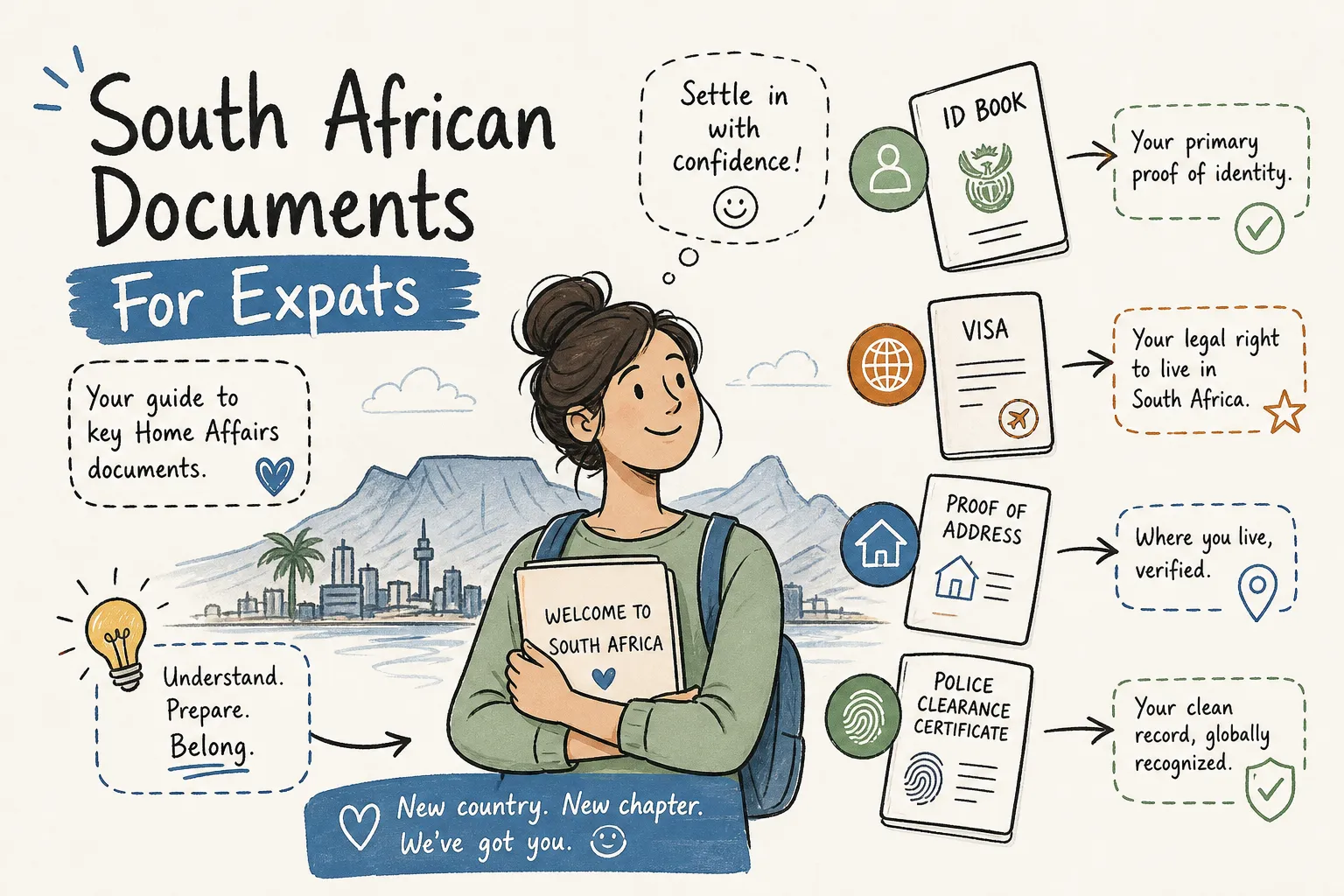
South African Home Affairs Documents Explained for Expats
South African Home Affairs documents explained for expats: if you're sitting thousands of miles from South Africa and need a document urgently, you've likely discovered that the Department of Home Affairs (DHA) website was built for someone who can physically walk into a branch in Pretoria. You can't. Many South Africans abroad report that this gap between what the department requires and what an expat can realistically do is one of the most frustrating parts of the process, and it's completely understandable.
Home Affairs covers a wide range of documents: unabridged birth and marriage certificates, passport renewals, citizenship retention, Letters of No Impediment, and travel documents for children. Each one has its own form number, supporting document requirements, fee structure and timeline. Submitting the wrong version of a document or the wrong form can cost you months. This is exactly why services like Authentic Documents SA exist: to manage these applications for South Africans who cannot walk into a Home Affairs office. This article gives you a clear breakdown of every major document category, three ways to apply from abroad, the forms and fees you need, and the apostille process explained plainly.
The major Home Affairs documents South African expats actually need
Not every expat needs every document. Before you start gathering paperwork, identify which category applies to your situation. The breakdown below defines each document type and its real-world use case so you can focus on what's relevant.
Unabridged birth and marriage certificates
An unabridged birth certificate is a full record drawn from the original register and includes both parents' details. It is not the short-format certificate printed at a Home Affairs desk. This distinction matters because the unabridged version is typically required for dual citizenship applications, registering children in foreign schools, and certain immigration or enrolment processes depending on the destination country, always confirm the specific requirement with the receiving institution or authority. Processing times are also longer precisely because records must be traced back to the original register in Pretoria.
The unabridged marriage certificate works the same way: it is the full civil record of your marriage, not a summary. You'll need it for spousal visa applications, name changes on foreign documents, and as supporting evidence for a Letter of No Impediment. Both document types require patience and planning, as they are not issued on demand.
South African passports and the BI-73 travel document
Renewing a South African passport from abroad is a distinct process from doing so inside the country. Both adult and child passports use form DHA-73 and are available through South African missions overseas. The Maxi Tourist Passport is also available at missions for those who travel frequently and need more pages. If you need to travel urgently and cannot wait for a full passport to be processed, the BI-73 Emergency Travel Certificate exists for exactly that scenario, though it is a short-term solution rather than a full replacement.
Child passport applications carry additional requirements. Both parents must sign the DHA-73, and if one parent is absent, a consent affidavit and certified copy of that parent's identity document are required. If the parents are divorced and only one has physical custody, a Letter of Permission to Issue a Passport is needed. Ensure all consent documents are in order before attending the mission; an incomplete set means returning for a second appointment.
Citizenship, retention and the Letter of No Impediment
Some South Africans who naturalised in another country without prior approval from the Department of Home Affairs are required to apply for retention of their South African citizenship. Form DHA-529 is central to this process. According to the My Home Affairs Online FAQ, citizenship reinstatement is one of the applications that can be completed fully online from anywhere in the world, using a foreign passport if your South African one has expired.
The Letter of No Impediment is a separate document that proves a South African citizen is free to marry abroad. It is issued by Home Affairs and is required by many foreign authorities before they will process a marriage involving a South African national. It also needs to go through DIRCO's Legalisation Section if your destination country requires an apostille, which adds a step to your planning timeline.
South African Home Affairs documents for expats: three ways to apply from abroad
Applying through a South African mission or consulate
Most Home Affairs services are available at South African embassies, high commissions and consulates. The mission acts as a forwarding agent: it receives your application, verifies your documents and forwards the file to DHA in Pretoria for processing. For biometric-dependent services like passport applications, an in-person visit to the mission is non-negotiable. Fingerprints, photographs and digital signatures must be captured on-site. Some missions use VFS Global as their intake point, so confirm your specific country's arrangement before assuming you can walk straight into the embassy.
For document requests such as unabridged birth certificates, some missions accept submissions by post or courier, though this depends on each mission's local instructions. Always download the specific checklist from your nearest South African mission rather than relying on the generic DHA website, because requirements vary between missions and the generic guidance can be misleading.
My Home Affairs Online and the biometric verification step
According to the My Home Affairs Online FAQ and GOV.ZA guidance, the portal pre-populates most of your information from existing DHA records once you've created a profile and verified your identity. The identity confirmation step uses a selfie for biometric authentication and may also request a passport scan, even if your passport has expired. One important limitation is clear: applications must be completed personally because biometric verification is required for security.
For expats, the portal works well for citizenship reinstatement applications, which can be completed fully online from anywhere in the world. Most other document types, including Smart ID cards and standard passports, still require in-person biometrics at a Home Affairs office or an enabled bank branch. The portal is a starting point for those services, not a complete end-to-end solution from overseas.
Using an authorised representative or document assistance service inside South Africa
For documents where neither the online portal nor your local mission can fully process the request, an authorised representative in South Africa can act on your behalf. This applies particularly to unabridged birth and marriage certificate requests, where the original register is traced in Pretoria. This is where Authentic Documents SA becomes directly relevant: as a private document assistance company, they manage in-country applications on behalf of overseas clients, handling submission, follow-up with DHA and courier delivery internationally, without requiring the expat to travel or to coordinate multiple parties across two countries.
Forms, supporting documents and fees: what to prepare
Key form numbers by document type
Knowing the correct form number saves time and prevents rejection. Here are the most common forms for expat applications:
- DHA-73: Passport applications for adults and children
- DHA-529: Citizenship determination, required alongside passport applications
- DHA-9: Fingerprint form for applicants aged 16 and older
- DHA-154: Birth certificate requests
- DHA-24: Birth registration for children born abroad
- DHA-288: Affidavit in support of birth registration, used at some missions
- DHA-1682: Insertion of the father's particulars in a birth registration
Missions publish their own consular checklists, and the required form set can differ slightly between them. Confirm with your specific mission before submitting anything.
Certified copies, translations and fee schedules
Official DHA overseas passport tariffs are: Adult Passport R1 200, Child Passport R1 200, Maxi Tourist Passport R2 400, and Emergency Travel Certificate R140. Individual missions charge in local currency, so the amount you pay will reflect the exchange rate applied by that mission. The South African High Commission in the United Kingdom, for example, lists a standard adult or child passport at £58 and civil-status documents such as birth, marriage and death certificates at £7 each. Verify current fees directly with the DHA tariff schedule and your specific mission's consular fees page, as rates are subject to change.
Getting certified copy and translation requirements wrong is a very common cause of application rejection. Originals or certified copies are required for most applications. Any document in a foreign language must be translated by a sworn translator, and that translation must itself be certified. A photocopy of a birth certificate is not acceptable, and neither is a computer printout of a civil record. Beyond these two, submitting documents to the wrong mission or DHA office is another frequent error that returns your application to square one. Prepare originals from the outset and you'll avoid the most common delay triggers in this process.
Getting your documents recognised abroad: apostille vs legalisation
The apostille and legalisation process is where many expats lose time, not because the rules are complicated, but because they apply the wrong route. Once you understand the logic, the path forward is clear.
The Hague Convention apostille route through DIRCO
If your destination country is a member of the Hague Apostille Convention, which includes the United States among its members, South African documents are legalised through a DIRCO Apostille Certificate. Original Home Affairs-issued documents, including unabridged birth certificates, marriage certificates, death certificates and Letters of No Impediment, are submitted directly to DIRCO's Legalisation Section in Pretoria. A High Court Apostille is the other option for certain document types heading to Hague countries, after which no further DIRCO processing is required.
DIRCO will ask which country the document will be used in at the time of submission, because that determines whether apostille or authentication is the correct route. Provide that information upfront to avoid unnecessary delays.
Non-Hague countries and the consular legalisation route
For countries not party to the Hague Convention, the process involves more steps. The document first goes through High Court Authentication, then to DIRCO for further authentication, and finally to that country's embassy or consulate in South Africa for consular legalisation. Each stage takes time. Build this into your planning if your destination country is not on the Hague Convention list.
What DIRCO will and won't accept
DIRCO accepts original Home Affairs-issued documents only. Abridged certificates, computer printouts and certified copies of civil-status records are not accepted for legalisation. The document must be valid at the time of submission. Police clearance certificates must also be originals, and certain document types may need to pass through a magistrate or the High Court before DIRCO will process them. Check these requirements before sending anything by courier to Pretoria.
What to realistically expect on timelines
Many expats underestimate how long Home Affairs processes take from overseas, and that miscalculation creates real problems when documents are needed for a visa deadline or a court date.
Based on official mission guidance, these are the realistic 2026 timelines you should plan around:
- Unabridged birth certificates from overseas: Standard estimate: 6 months. Complex tracing: 6, 9 months. Exceptional cases: up to 12 months or longer.
- Passport renewals through a mission: Generally faster than civil record requests since biometric data is captured on-site, but timelines vary by mission and DHA workload.
- Citizenship retention applications: Several months given the DHA adjudication process.
- Apostille through DIRCO: Relatively quick once you have the original document; the bottleneck is obtaining that original in the first place.
The most common delay triggers are incomplete forms, missing supporting documents, non-original documents submitted for legalisation, untranslated foreign documents, incorrect fee payment methods and applications sent to the wrong mission or DHA office. Errors discovered after submission mean the application is returned, corrected and resubmitted, which can add months to your wait. Use the specific mission's checklist, not a generic DHA checklist, every time.
When document assistance genuinely saves you time and stress
Not every expat needs outside help. If your situation is straightforward, you're within reasonable distance of a South African mission, and your documents are in order, you can work through the process described above directly. But for unabridged birth or marriage certificates, citizenship retention, Letters of No Impediment, or any situation where the application must be managed inside South Africa, the value of professional end-to-end management is significant.
Authentic Documents SA is a private document assistance company that manages the full application lifecycle for South Africans living overseas. In practice, that means preparing and submitting applications to the correct DHA channels in South Africa, following up on progress, handling the DIRCO apostille or legalisation step, and couriering completed documents to wherever you are in the world. You have a single point of contact from the moment you start to the moment your documents arrive, no need to coordinate between a consulate abroad, a representative inside South Africa and DIRCO simultaneously.
A quick checklist to start your application today
- Identify which document you need using the breakdown in this article
- Locate the nearest South African mission and download their specific consular checklist
- Gather your originals: South African ID, passport, any existing certificates
- Confirm whether your destination country is a Hague Convention member (apostille) or not (legalisation)
- Match your document type to the correct form number from the list above
- Build in realistic timeframes: plan for a minimum of 6 months for civil records, longer if record tracing is required
- Contact Authentic Documents SA if you need end-to-end management or cannot appear at a mission in person
Home Affairs documents for South African expats: start with the right information
South African Home Affairs documents are not simple from overseas. But the process becomes manageable once you know which document applies to your situation, which channel to use, and what timelines to build into your plans. The form guide and checklist in this article give you a solid foundation to start from.
Use the checklist above as your immediate action point and refer back to the form guide each time you're preparing a specific application. The most costly mistakes in this process are made before anything is submitted: wrong form, wrong format, missing original. Getting those details right from the start protects both your timeline and your money.
If you need help with South African Home Affairs documents as an expat, particularly where applications must be managed inside South Africa without being there yourself, Authentic Documents SA handles these cases every day for South Africans living abroad. From unabridged certificates to DIRCO apostille processing and worldwide courier delivery, they manage the full process on your behalf. Reach out to start your application today.