How to Get a South African Police Clearance for Canada Visa 2026
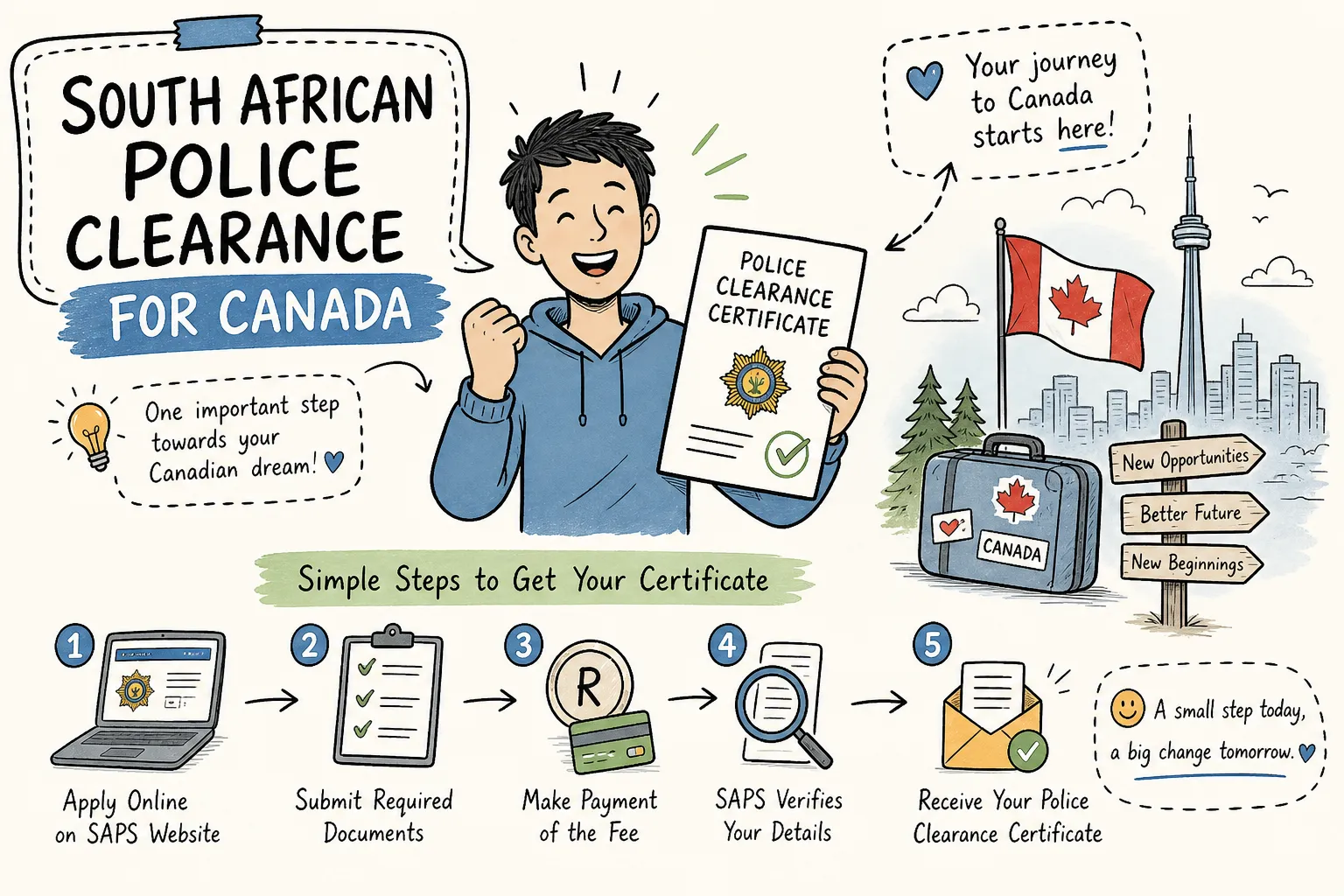
You're midway through your Canadian permanent residency or visa application. You've pulled together everything IRCC has asked for, and then you hit it: the requirement for a South African police clearance certificate for your Canada visa. From inside South Africa, the process is already cumbersome. From Canada, the United States, or anywhere else abroad, it can feel genuinely impossible to coordinate between SAPS, DIRCO, and IRCC without missing something critical.
The frustration is real. You need to source the right fingerprint form, find someone to take your prints overseas, pay a SAPS fee in rands from abroad, courier a physical pack to Pretoria, then wait weeks for a certificate that IRCC might still reject if a single detail is wrong. The good news is that the process, once you understand the exact sequence, is entirely manageable. At Authentic Documents SA, we handle South African government document applications for clients living abroad every single day, and this guide reflects exactly what the South African police clearance certificate process for Canada visa applications looks like in 2026.
By the time you finish reading, you will know which certificate format IRCC accepts, what the complete SAPS application package contains, how fingerprinting works from outside South Africa, whether you need an apostille for Canada, realistic timelines, and the specific mistakes that cause rejections. Start with what IRCC actually requires, because that determines everything downstream.
What IRCC actually requires from your South African police clearance certificate for Canada visa applications
Before you touch a fingerprint form, you need to understand what Canada's immigration authority will and will not accept. Getting the SAPS certificate issued correctly does not help if you deliver it to IRCC in the wrong format.
The exact format IRCC accepts (and what it will reject)
IRCC requires a scanned colour copy of the original SAPS-issued certificate. Certified true copies are not accepted, and neither are black-and-white scans. If your certificate is not in English or French, you must include the original alongside a certified translation into one of those languages.
The most common South African-specific rejection, one that trips up a significant number of applicants, is submitting an Ideco Biometrics certificate. IRCC's published guidance is explicit: Ideco Biometrics certificates are not valid for immigration purposes. Your certificate must come from SAPS only.
Validity windows you need to plan around
IRCC applies a validity rule based on your current country of residence. If the certificate relates to South Africa and South Africa is where you currently live, it must have been issued within six months before you submit your application. If you lived in South Africa previously but no longer do, the certificate must have been issued after your last stay of six or more consecutive months there.
This distinction matters enormously for applicants who have lived in multiple countries. If you spent several years in South Africa before moving to Canada and are now applying for permanent residency, IRCC still wants that South African certificate. Start the application process early enough that the certificate remains valid by the time you submit your full IRCC package.
What SAPS needs from you: documents, fingerprints, and fees in 2026
With the IRCC standard clear, the next step is assembling the correct SAPS application package. Every item on this list is required. A missing document is the primary reason applications stall at the Criminal Record and Crime Scene Management centre in Pretoria.
Your full SAPS application checklist for a South African police clearance certificate
The complete package requires the following four items, all are mandatory:
- A completed SAPS application form
- A full set of fingerprints taken on the SAPS 91(a) form
- A certified copy of your South African ID or passport (not laminated)
- Proof of payment of the prescribed SAPS fee
If you have a maiden surname or any name change you want reflected on the certificate, include documentary proof, for example, a certified marriage certificate. The certified ID or passport copy must not be laminated; SAPS will not process laminated documents, and this applies at the DIRCO legalisation stage as well. Produce a flat, clear certified copy and keep it that way throughout the process.
Fees and how to pay in 2026
The prescribed SAPS fee is R190 per application, and it is non-refundable. You can pay in cash at a SAPS police station, or electronically into SAPS's ABSA cheque account: account number 4054522787, branch code 632005, Swift code ABSAZAJJXXX, payable to the National Commissioner.
For applicants overseas, the electronic transfer is the practical route. Keep your proof of payment in both digital and physical form, because it forms part of the submission pack that travels to Pretoria. An application received without payment confirmation will not be processed.
Applying from inside South Africa: the process from start to submission
If you are still in South Africa, or have a trusted person assisting you there, the in-person route is more straightforward than the overseas alternative, though it still requires attention to detail at each step.
Getting your fingerprints done correctly at a SAPS station
Go to your nearest SAPS police station and request that your full set of fingerprints be taken on the SAPS 91(a) form. For the in-country route, fingerprints must be taken by SAPS, not by a private fingerprinting bureau. Bring your original South African ID or passport for identity verification, along with a certified copy of the same document, because that copy stays with your application package when it leaves the station.
Submitting your application to the SAPS Criminal Record Centre in Pretoria
Once the fingerprints are taken and your pack is complete, submit the full application to the Head of the South African Criminal Record Centre in Pretoria, marked for attention: Police Clearance Certificates. The physical and courier address is Bothongo Plaza West, CRC Client Service Centre, 1st Floor, Room 14, 271 Francis Baard Street, Pretoria 0001. You can submit in person or via courier.
SAPS states that official processing takes approximately 15 working days from the date of receipt of all required documents. In practice, 2026 real-world timelines are longer. Plan for six to eight weeks total when you factor in transit time on both ends and the possibility of backlogs at the Criminal Record Centre.
How to get your South African police clearance certificate for Canada visa applications from abroad
This is the section that matters most for the majority of people reading this guide. If you are a South African living in Canada, the United States, or anywhere else outside the country, you cannot walk into a SAPS office. Here is every legitimate route available to you.
Fingerprinting options when you are outside South Africa
SAPS explicitly allows overseas applicants to have fingerprints taken at a police station in the country where they currently reside, or at a South African Embassy or High Commission. The prints should be on the SAPS 91(a) form where available. If the SAPS 91(a) form is not accessible in your country, the official fingerprint form of your current country is acceptable.
In Canada and the United States, several professional fingerprinting services provide certified ink fingerprint cards for overseas government submissions. Some Canadian providers offer ink fingerprinting specifically for South African PCC applications, including on the SAPS 91(a) form. If you are in the US, contact your nearest South African Consulate or a professional fingerprinting service that handles foreign government submissions, and confirm they can provide ink prints on an acceptable form.
Sending your application package directly to SAPS Pretoria from overseas
Once your fingerprints are done and the full pack is assembled, SAPS allows overseas applicants to courier the package directly to the Criminal Record Centre in Pretoria at the address noted above. Use a reliable tracked courier service and retain your tracking details.
One important point: applications received from abroad are not automatically returned to the applicant. The certificate is held at SAPS until you arrange collection or forwarding. Track progress using your reference number through the SAPS Criminal Record Centre contact line at 012 393 3928, or via the SAPS online status portal using your reference number or date of birth and surname. SAPS sends SMS notifications at application receipt and completion if a South African cellphone number was provided on the form.
How Authentic Documents SA removes the complexity for South Africans abroad
For South Africans living in the US, Canada, or elsewhere who do not want to coordinate fingerprinting logistics, SAPS submission, and IRCC format requirements on their own, Authentic Documents SA provides a fully managed, end-to-end service. As specialists in South African government documentation for clients abroad, the team prepares the full application package, guides clients through the overseas fingerprinting step, handles direct submission to SAPS Pretoria, monitors progress, and delivers the final certificate via secure international courier.
This removes the risk of a rejected application due to missing documents, an incorrect fingerprint form, or an improperly formatted certificate, and eliminates any need to travel back to South Africa at any point in the process. For South Africans working against IRCC deadlines, having a specialist manage the process from the start is often the difference between a smooth application and a costly delay.
Does your South African police certificate need an apostille for Canada?
This question causes more confusion than almost any other part of the process. For IRCC, the answer is straightforward: no apostille is required. But the full picture is worth understanding.
When apostille applies to a South African PCC
An apostille is an international authentication issued by DIRCO that certifies a South African document for use in countries party to the Hague Convention. For Canadian immigration specifically, IRCC's published guidance does not require the South African police clearance certificate to be apostilled before submission. You submit the SAPS certificate as issued, provided it meets the format and validity rules covered above.
The apostille requirement comes into play when another authority specifically requests it. A Canadian employer, a provincial licensing body, a foreign embassy, or a university admissions office may ask for an apostille on top of the SAPS certificate. If IRCC is your only intended recipient, skip this step.
How the DIRCO legalisation process works if you do need it
If another authority requires apostille authentication of your police clearance, the process runs through DIRCO's legalisation services in Pretoria. DIRCO accepts only original, valid SAPS-issued police clearance certificates. The certificate must not be older than six months at the time of submission, and laminated documents are not acceptable.
As of 2026, the apostille service at the DIRCO counter in Pretoria is available free of charge. For booked in-person submissions of five documents or fewer, processing is completed the same day. Factor in additional processing and courier time if your timeline requires authentication beyond the IRCC submission itself. Authentic Documents SA handles DIRCO apostille authentication as part of its full-service offering for clients who need this step.
Timelines, fees, and the most common reasons South African police clearance applications get delayed
There is a meaningful gap between SAPS's official processing time and what applicants typically experience in 2026. Knowing both gives you a realistic basis for planning your Canadian immigration timeline.
What to expect from SAPS in 2026
SAPS's official position is that processing takes 15 working days from receipt of a complete application, excluding postal time. In practice, multiple 2026 sources report turnarounds of six to eight weeks for applications submitted from abroad, once courier transit on both ends is included. Backlogs at the Criminal Record Centre account for much of the gap between the official figure and real-world experience.
Build at least eight to ten weeks into your Canadian immigration timeline. If your IRCC application has a hard submission window, start the SAPS process as early as possible. The six-month validity rule from IRCC gives you a working window, but that window shrinks fast when applications run long.
The specific mistakes that delay or invalidate applications
The most common causes of delay at SAPS are worth knowing before you submit:
- Submitting an incomplete document set
- Using a fingerprint form that SAPS does not accept
- Including a laminated certified copy instead of a flat one
- Omitting the proof of payment
Each of these results in the application being held or returned, adding weeks to the process. For IRCC specifically, the most common South African submission failures are submitting an Ideco Biometrics certificate instead of a SAPS-issued one, and uploading a black-and-white scan instead of a colour scan. Both result in immediate rejection. Getting the document checklist right before you submit is the single most effective way to avoid a second round of SAPS processing time. There is no shortcut through the wait once the pack is in Pretoria; your only leverage is submitting a complete, correct package the first time.
Start early and get it right the first time
The logic here is simple: match what IRCC accepts to what SAPS produces, and choose a submission route that fits your location. A South African police clearance certificate for Canada visa and immigration applications is not a complicated document. It becomes complicated when applicants skip steps, use the wrong fingerprint form, or submit in the wrong format to IRCC.
For South Africans living abroad, the coordination burden is real. You are managing a physical application process in South Africa from thousands of kilometres away, against a validity window and an IRCC deadline that do not slow down for administrative hiccups. That is precisely the situation Authentic Documents SA was built for.
If you would rather have a specialist manage the process, from fingerprinting guidance and full application preparation through to SAPS submission and international courier delivery, contact the team at Authentic Documents SA. The earlier you start, the more buffer you have before your IRCC deadline arrives.
Frequently asked questions: South African police clearance certificate for Canada visa 2026
How long is a South African police clearance certificate valid for IRCC?
If you currently live in South Africa, the certificate must have been issued within six months before your IRCC submission date. If you previously lived in South Africa but no longer do, it must have been issued after your last stay of six or more consecutive months in the country.
Can I get a South African police clearance certificate while living in Canada?
Yes. SAPS allows overseas applicants to have fingerprints taken at a local police station or South African Embassy, then courier the full application pack to the Criminal Record Centre in Pretoria. Authentic Documents SA manages this entire process on behalf of South Africans in Canada.
Does my South African PCC need to be apostilled for a Canada visa?
Not for IRCC. Submit the SAPS-issued certificate as-is, provided it meets IRCC's format and validity requirements. An apostille is only needed if a separate authority, such as a Canadian employer or licensing body, specifically requests one.
What is the SAPS fee for a police clearance certificate in 2026?
The prescribed fee is R190 per application, payable in cash at a SAPS station or via electronic transfer into SAPS's ABSA cheque account. The fee is non-refundable.
How long does SAPS take to process a police clearance application in 2026?
The official processing time is 15 working days from receipt of a complete application. Real-world turnarounds in 2026, particularly for overseas submissions, are typically six to eight weeks once courier transit is included on both ends.
Why Use a Professional Assistance Service?
Many applicants prefer expert help because it can reduce delays, confusion, and repeated follow-ups.
Authentic Documents SA assists clients locally and internationally with document applications and secure courier options.
Police clearance certificate South Africa
Need Help?
If you need assistance with a Police Clearance Certificate in South Africa, contact Authentic Documents SA for professional support.
https://www.authenticdocumentssa.co.za