How to Get a South African Police Clearance for Dubai 2026
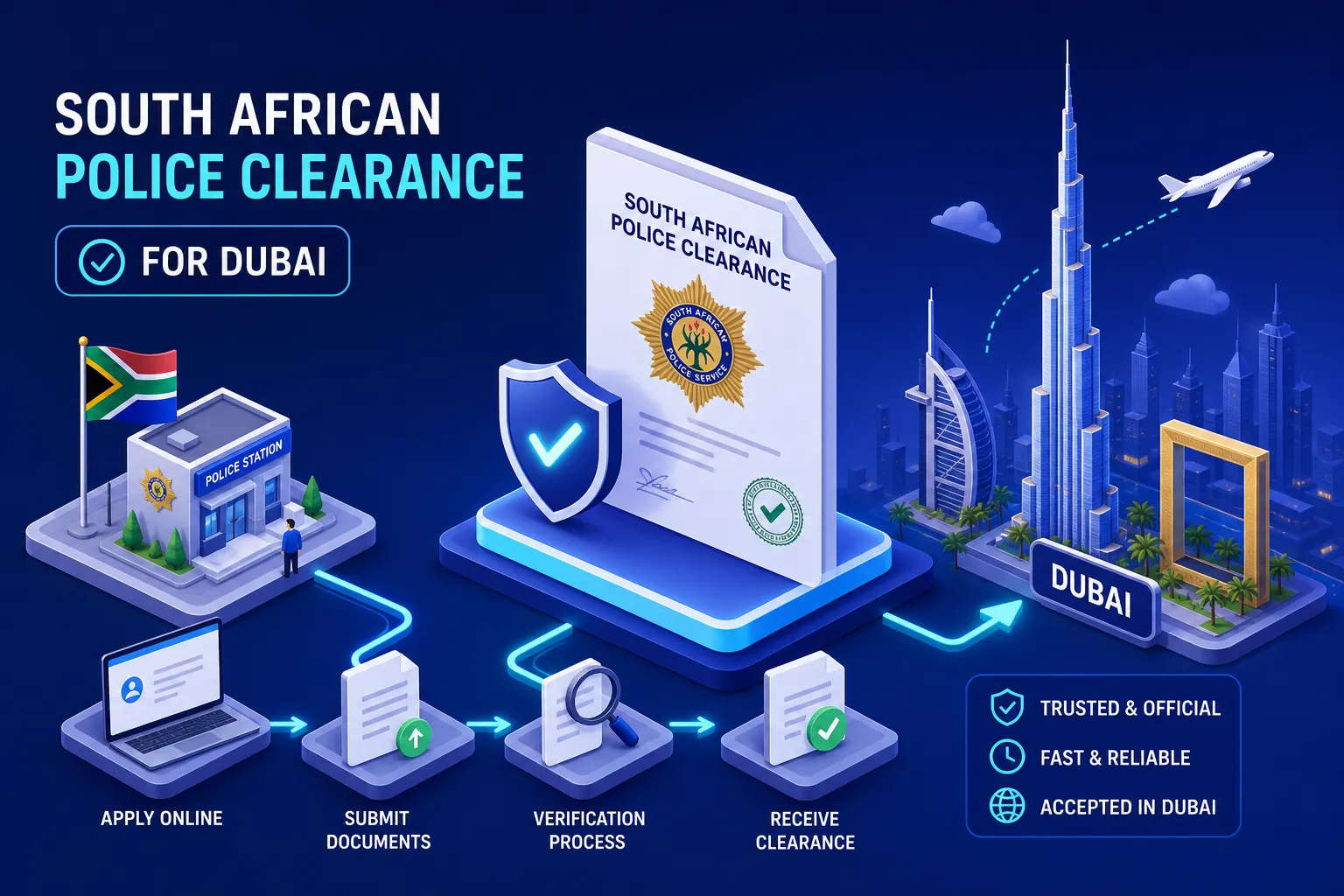
South Africans working in Dubai face a specific problem that catches many off guard: UAE employers, immigration authorities, and typing centres don't just want a South African Police Clearance Certificate. They want one that has been formally legalised through a chain involving three separate institutions spread across two countries. When you're managing this from thousands of kilometres away, without easy access to SAPS offices, DIRCO, or the UAE Embassy in Pretoria, the process can feel genuinely unworkable.
This guide covers the complete South African police clearance certificate for UAE Dubai applications, from the SAPS submission stage through to a fully attested, UAE-accepted document in 2026. It covers what documents SAPS needs, how to get your fingerprints taken in the UAE, and exactly what legalisation steps must happen before UAE authorities will accept your certificate. Get this process wrong and your visa or employment application stalls, potentially for months. Get it right and you move forward on schedule.
If you would rather have a specialist manage the process professionally from South Africa, remote document assistance services exist specifically for that purpose, covered in detail later in this article.
What UAE and Dubai authorities actually require from your South African PCC
UAE employers, residency visa processing centres, and immigration authorities will not accept a raw SAPS-issued certificate. The document must travel through a formal legalisation chain before it carries any weight in the UAE. That chain runs in one direction only: SAPS issues the PCC, DIRCO (the Department of International Relations and Cooperation) legalises it, and then the UAE Embassy in Pretoria attests it.
A significant source of confusion is the difference between an apostille and UAE consular legalisation. South Africa issues apostilles under the Hague Convention for use in countries that have signed that convention. The UAE has not signed the Hague Convention, which means an apostille alone does not satisfy UAE requirements. If you have read elsewhere that an apostille covers everything, that advice does not apply to UAE submissions. The correct route for UAE use is DIRCO legalisation followed by UAE Embassy attestation, full stop.
Why an apostille alone won't work for UAE submissions
The apostille system is a shortcut that works between Hague Convention member states. When a receiving country is not a Hague Convention signatory, the apostille route simply doesn't apply, regardless of what the issuing country offers. Since the UAE falls outside the Hague Convention, the DIRCO legalisation stamp is step one of the UAE chain, not the endpoint. Submitting a SAPS PCC with only an apostille to UAE authorities is a common and costly mistake that results in rejection of your full application package.
The 90-day validity rule and why it shapes your entire timeline
UAE authorities generally treat a South African PCC as valid for 90 days from the date of issue. Some UAE employers or authorities extend this to six months, but 90 days is the safest working assumption until you confirm the requirement with your specific receiving party. The critical implication is that the SAPS-to-DIRCO-to-UAE Embassy process can itself take several weeks or longer. Factor that into your planning from day one, not as an afterthought once you already have the certificate in hand.
What SAPS requires before they issue your PCC
Incomplete submissions are the single most common reason for delays at the SAPS Criminal Record Centre in Pretoria. Knowing exactly what goes into the application package before you submit eliminates that risk entirely.
The core application package
SAPS requires a completed application form, a full set of fingerprints on the SAPS 91(a) form, a certified copy of your South African ID or passport, and proof of payment. If the certificate needs to reflect a maiden surname or other previous surnames, you must also include certified documentary proof of that name, such as a marriage certificate. Every document must meet SAPS's own quality standards; a poorly certified copy or an incomplete fingerprint set will result in the application being returned.
Current SAPS fees and how to pay in 2026
The prescribed SAPS application fee in 2026 is R190 per application. Older figures of R91 or R150 still circulate on outdated third-party websites, but those figures are not current. Payment can be made in cash at a police station or electronically into the SAPS account. For overseas applicants submitting by post or courier to the SAPS Criminal Record Centre in Pretoria, proof of payment must accompany the physical application package. If you are submitting remotely, confirm the current electronic payment details directly with SAPS or your document service provider before transferring funds.
Getting your fingerprints taken when you're in Dubai or abroad
For many South Africans in the UAE, fingerprinting is the step that feels most uncertain. The good news is that SAPS explicitly allows overseas applicants to have fingerprints captured outside South Africa. The prints must be full, rolled fingerprints on either the SAPS 91(a) form or the official fingerprint form of the country where you reside, and the form must be signed and stamped by the fingerprinting officer.
Your options for fingerprinting in the UAE
In the UAE, your primary options are the South African Embassy or Consulate (subject to their current capacity and appointment availability) or an approved local fingerprinting facility. Before attending either, confirm which fingerprint form is required for your specific application, because prints submitted on the wrong form are rejected. Partial prints or those affected by ink quality are also a common rejection point. Attend the fingerprinting appointment with clean, dry hands and confirm with the officer that each finger has been fully and clearly captured before you leave.
What to do if the SA Embassy cannot assist with fingerprints
Some South African diplomatic missions operate with limited consular capacity and may not offer fingerprinting services at all locations on all days. If that is the case for your nearest mission, a local police station or certified fingerprinting facility in the UAE is the alternative. The key requirement is that the prints are captured on the correct official form and that the form is properly signed and stamped by the capturing officer. Digitally captured fingerprints are not accepted by SAPS for PCC applications; only ink-on-paper submissions are valid. Confirm the form requirement before booking any fingerprinting appointment to avoid wasting time.
The legalisation chain for your PCC for UAE Dubai applications, step-by-step 2026 guide
This is the most misunderstood part of the entire process. The legalisation steps must happen in the correct sequence, because submitting documents out of order invalidates the process and requires you to start again.
Step 1: DIRCO legalisation in Pretoria
Once SAPS issues the original PCC, it must go directly to the DIRCO Legalisation Section in Pretoria before anything else happens. DIRCO only accepts the original certificate; certified copies, scans, and laminated versions are not accepted. Critically, DIRCO will not legalise a certificate that is older than six months from the date of issue. This is precisely why timing your SAPS application correctly matters: if the certificate sits in a drawer too long before reaching DIRCO, you must apply to SAPS again from scratch. DIRCO's legalisation section is located at the OR Tambo Building, 460 Soutpansberg Road, Rietondale, Pretoria. If couriering the document, include a cover letter inside the package as required by DIRCO.
Step 2: UAE Embassy attestation in Pretoria
After DIRCO legalises the certificate, it proceeds to the UAE Embassy in Pretoria for attestation. This step confirms to UAE authorities that the document is authentic and has been verified by both the South African government and the UAE's own diplomatic mission operating in South Africa. Completing the DIRCO and UAE Embassy steps in Pretoria is generally sufficient for the full legalisation chain, without requiring further UAE MOFA attestation inside the UAE. However, because requirements vary across UAE receiving authorities, confirm the current acceptance criteria with your specific employer, immigration office, or typing centre before submitting. Some UAE authorities may also request an Arabic translation of the certificate, so check that requirement early in your planning.
Processing times, realistic costs, and what causes delays
Planning a UAE visa or employment timeline requires honest numbers, not optimistic estimates. Here is the current picture for South African police clearance certificate for UAE Dubai applications in 2026.
What to expect from SAPS processing in 2026
SAPS's internal target is approximately 14 to 15 working days from receipt of a complete application. In practice, backlogs at the Criminal Record Centre in Pretoria regularly push real-world processing to six to eight weeks, and in peak periods some applicants report waiting up to three months. Adding DIRCO legalisation and UAE Embassy attestation on top of that means the full end-to-end process commonly takes 10 to 14 weeks when managed independently from abroad. The single most effective thing you can do to protect your timeline is to submit a complete, correct application the first time. Any error or missing document resets the clock entirely.
Full cost breakdown: SAPS to UAE-ready document
The costs involved in getting a UAE-ready South African PCC break down as follows:
- SAPS application fee: R190
- DIRCO legalisation fee: variable; confirm directly with DIRCO at the time of submission
- UAE Embassy attestation fee: variable; confirm with the UAE Embassy in Pretoria
- Courier costs: domestic courier within South Africa between SAPS, DIRCO, and the UAE Embassy, plus international tracked courier to the UAE
- Full-service assisted option: typically R1,500 to R4,000 all-in, depending on the provider and urgency requirements
No official SAPS fast-track lane exists for standard PCC applications. Faster timelines offered by professional service providers come from precise submission, active follow-up with the Criminal Record Centre, and eliminating the errors that cause ordinary self-managed applications to be delayed or returned.
How to manage the entire process from Dubai without returning to South Africa
Managing SAPS, DIRCO, and UAE Embassy logistics from Dubai is not merely inconvenient. It involves coordinating submissions across multiple government departments with strict document handling requirements, no online tracking, and tight validity windows. A single misstep, such as submitting the wrong fingerprint form or missing the DIRCO age restriction, means restarting a process that takes months.
What a specialist remote document service handles on your behalf
Authentic Documents SA is a South Africa-based professional document assistance service that manages the complete PCC process for clients living abroad, including in the UAE. Their end-to-end service covers:
- Guidance on getting your fingerprints taken locally in Dubai
- Preparation and submission of the full SAPS application package to the Criminal Record Centre
- Active follow-up during SAPS processing
- Submission to DIRCO for legalisation
- Coordination of UAE Embassy attestation in Pretoria
- Secure international courier delivery directly to your address in the UAE
For someone managing a UAE residency permit or employment application from abroad, this removes both the risk of application errors and the uncertainty of managing timelines across three institutions with no physical presence in South Africa. Authentic Documents SA focuses exclusively on South African government document processing for international use, which means they carry practical knowledge of SAPS, DIRCO, and embassy requirements that generalist services cannot match at a comparable cost.
Getting your authenticated PCC delivered directly to the UAE
Once the full legalisation chain is complete, the authenticated certificate is dispatched by tracked international courier directly to your Dubai address, no South African proxy, local contact, or return trip required. For anyone working against a UAE application deadline, the most important thing to understand is that the 10 to 14 week realistic timeline makes early action essential. Starting this process at the first opportunity, rather than waiting until a visa deadline is approaching, is the difference between a smooth application and a costly delay.
What to take away from this guide
The complete South African police clearance certificate for UAE Dubai applications follows a clear sequence: submit the correct SAPS application package with proper fingerprints, receive the original PCC, submit it to DIRCO for legalisation, proceed to UAE Embassy attestation in Pretoria, and submit the completed document to UAE authorities within the 90-day validity window from the issue date. This 2026 guide covers every stage of that chain.
The most common failure points are incomplete SAPS application packages, fingerprints taken on the wrong form, and the mistaken assumption that an apostille satisfies UAE requirements. None of these errors are difficult to avoid with the right preparation, but each one adds weeks or months to your timeline if they occur.
If you are managing a South African police clearance certificate application for UAE visa or employment purposes from abroad and need the process handled correctly the first time, working with a specialist like Authentic Documents SA removes the guesswork entirely. Contact the team to discuss your specific UAE application requirements and timeline before delays become a problem.
Why Use a Professional Assistance Service?
Many applicants prefer expert help because it can reduce delays, confusion, and repeated follow-ups.
Authentic Documents SA assists clients locally and internationally with document applications and secure courier options.
Police clearance certificate South Africa
Need Help?
If you need assistance with a Police clearance certificate in South Africa, contact Authentic Documents SA for professional support.
https://www.authenticdocumentssa.co.za