South African Police Clearance Certificate 2026 Guide
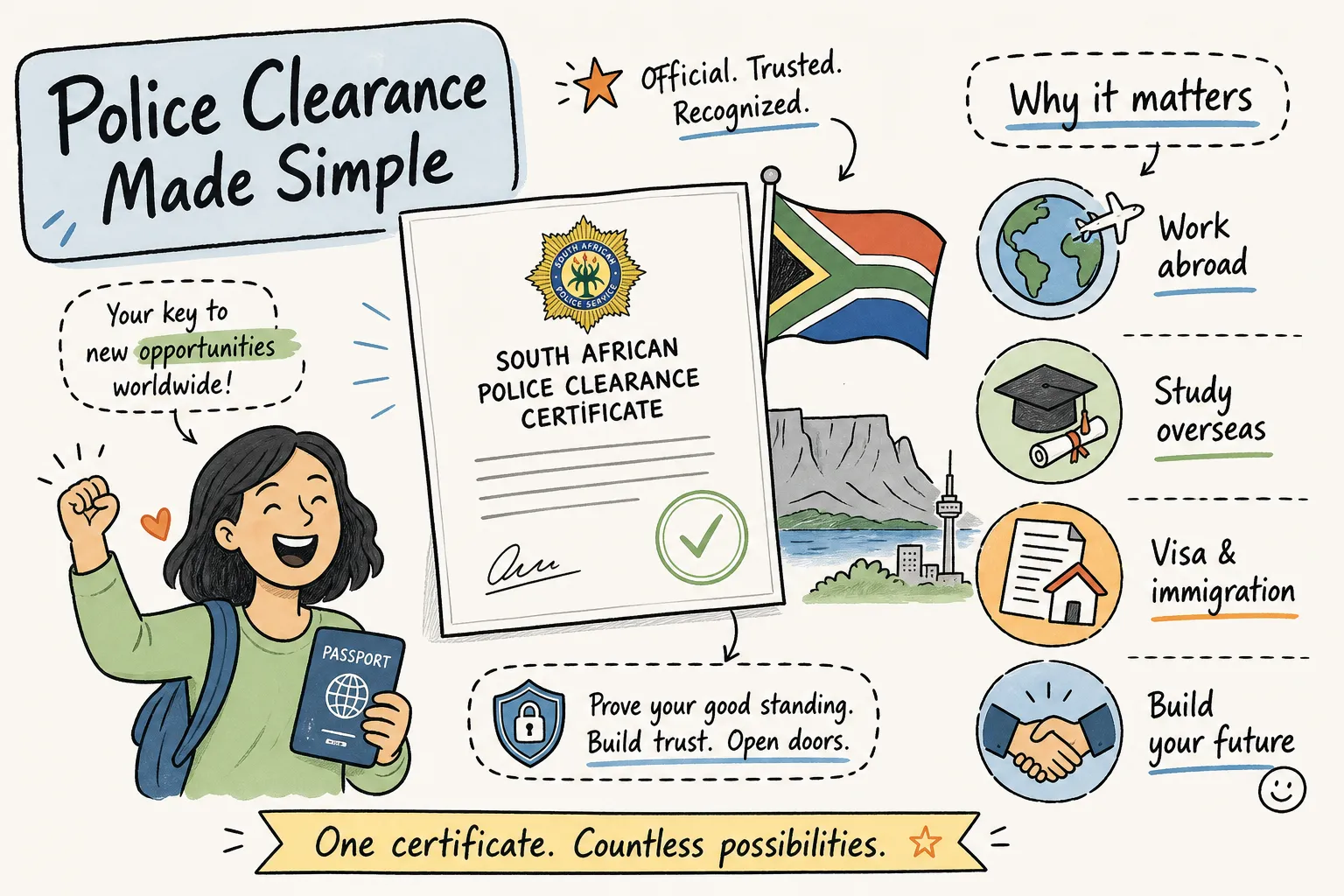
What is a police clearance certificate in South Africa? If you're sitting in the US with a job offer or an immigration application on the table, and the checklist in front of you has one line you can't tick, a South African Police Clearance Certificate, this 2026 guide is for you. You haven't lived in South Africa for years. You can't walk into a SAPS station. You're not entirely sure what the certificate confirms, or how to get one from thousands of kilometres away without losing months in the process.
This South African Police Clearance Certificate 2026 guide answers all of that. You'll find out what a South African Police Clearance Certificate is, who requires it and why, exactly what SAPS needs from you to issue one, how to apply as a South African living in the United States, what realistic timelines look like in 2026, and which mistakes trip up most applicants before they even realise it. For South Africans in the US who want professional help navigating this from start to finish, specialist services like Authentic Documents SA exist precisely for this situation, and we'll cover that too.
What is a Police Clearance Certificate in South Africa? (2026 guide)
Who issues it and what it officially confirms
The South African Police Service is the sole authority that issues Police Clearance Certificates in South Africa. Applications are processed through the Criminal Record and Crime Scene Management unit in Pretoria, not at local police stations. The certificate is an official government document confirming whether the applicant has any criminal convictions recorded against their name in South Africa, or whether their record is clean. It is not a private background check or a third-party verification report; it carries the full authority of the South African government.
How long a PCC remains valid
A PCC does not carry a universal expiry date printed on the face of the document, but receiving institutions set their own validity windows. DIRCO's legalisation section will not accept a PCC older than six months for apostille purposes. Most immigration authorities and international employers treat PCCs as valid for three to six months from the date of issue, though this varies by recipient institution and destination country. Check your specific recipient's requirements before you apply, so you time the application correctly and don't arrive at a submission deadline with a certificate that has already passed its window.
When you'll need one: immigration, employment and visa applications
South African PCCs and the immigration process
A South African Police Clearance Certificate is a standard requirement across a wide range of immigration scenarios. For South Africans going through consular immigrant visa processing at a US Embassy or Consulate, the Department of State routinely requires police certificates from all countries where the applicant has lived for a relevant period. In many cases the certificate also needs to carry a DIRCO apostille to be legally recognised in the destination country, which adds a separate step on top of the SAPS application.
Employment, professional licensing and university enrolment
Beyond immigration, a South African Police Clearance Certificate appears on checklists across several other contexts. US employers and international companies conducting background verification on South African candidates frequently request one as part of their vetting process. Skilled worker visa applications across jurisdictions including the UK, Canada, and Australia list it as a mandatory document. Postgraduate programmes and professional licensing bodies in the US and elsewhere also include it in their enrolment or registration requirements. An expired or unapostilled PCC in any of these situations is one of the fastest ways to stall an otherwise complete application.
What SAPS requires for your PCC application
The fingerprint requirement: the SAPS 91(a) form
The cornerstone of any PCC application is a full set of fingerprints captured on the official SAPS 91(a) form. For applicants inside South Africa, fingerprints must be taken at a SAPS station by a SAPS official. For those abroad, SAPS permits fingerprints to be taken at a local police station in the country of residence or at a South African Embassy or High Commission. The completed fingerprint form must accompany the full application package when it is submitted to Pretoria. Incomplete or poor-quality fingerprints are a common reason applications are rejected or delayed, often requiring the entire process to be restarted from scratch.
Identity documents, supporting paperwork and payment
Beyond the fingerprints, SAPS requires a fully completed application form, a certified copy of your South African ID or passport, and proof of payment of the prescribed fee of R190 per application. Payment can be made in cash at a SAPS station or via electronic transfer to the SAPS account, and a copy of the proof of payment must be included in the application package. If you need a maiden name or a previous surname to appear on the certificate, you must state this in the application and include documentary proof, such as a certified marriage certificate. Every document in the package must be in order before submission, a single missing item or an uncertified copy is enough to delay the entire application.
How to apply for a PCC from the US, 2026 guide
Your practical options as a South African living abroad
As a South African in the US, you have three realistic routes for capturing your fingerprints. You can attend a South African Consulate General, for example in New York, where consular staff can fingerprint you directly onto the SAPS 91(a) form. Some local US police departments and sheriff's offices will also take ink fingerprints on the SAPS form if you contact them in advance to confirm, though practice varies by department and is not universally available. You can also use a private fingerprinting service that provides ink prints on the correct official SAPS form; such services are accepted by SAPS provided the prints are ink-based and captured on the correct form. Once your fingerprints are captured, the complete application package is couriered or posted directly to the SAPS Criminal Record Centre in Pretoria for processing. Consulates and embassies are points of fingerprint capture only; SAPS processes all applications centrally in Pretoria, though applicants may also send completed packages directly.
The apostille step for international legal recognition
A PCC issued by SAPS is a South African government document. For it to carry legal weight in the United States or any other country party to the Hague Convention, it requires a DIRCO apostille . The apostille is a government-issued authentication stamp confirming the document's origin and the validity of the official signature on it. DIRCO's legalisation service is officially free of charge, but it runs as a separate process after the PCC is issued and adds its own processing time to the overall timeline. Coordinating the SAPS application, the DIRCO apostille, and international courier delivery simultaneously from the US is exactly where most applicants encounter delays they didn't anticipate.
Timelines, costs and what can go wrong
What to realistically expect in 2026
SAPS's official estimate is approximately 14 to 15 working days to finalise a PCC once a complete application reaches Pretoria, excluding postal and delivery time. The real-world picture is considerably different for most applicants. Straightforward cases commonly take two to eight weeks, while applications submitted from abroad often run to three to six months through standard postal channels, owing to international transit delays and routing complexity. Add DIRCO apostille processing, which can take one week to several weeks depending on workload, and international courier delivery, and the total end-to-end timeline is rarely quick.
Third-party service providers may offer faster handling at additional cost, with some advertising turnaround times of 5 to 30 working days from abroad. These are provider claims rather than SAPS guarantees; SAPS does not publish an official expedited processing lane. Plan the full process well ahead of your submission deadline, not as a last-minute item.
Mistakes that delay or reject your application
The most common pitfalls follow a consistent pattern. Applicants submit uncertified copies when certified ones are required. Fingerprints are incomplete, smudged, or captured on the wrong form. The R190 proof of payment is missing from the package. Name-change documents are omitted when a maiden name is needed on the certificate. Many applicants also fail to account for the DIRCO apostille step in their planning, realising only after the PCC arrives that they still need another round of processing before the document is usable internationally. A rejected application means starting over, and in 2026 that can cost months of additional waiting.
Why South Africans in the US use a specialist service
What an end-to-end PCC service actually handles
This is where Authentic Documents SA comes in directly. The service manages every step of the process on your behalf:
- Advising you on the correct fingerprint process for US-based applicants
- Reviewing all your documents before submission to catch errors before they cause rejections
- Handling submission to SAPS in Pretoria and following up on progress
- Coordinating the DIRCO apostille once your PCC is issued
- Delivering the final authenticated certificate to your door via secure international courier
You don't need to navigate SAPS requirements, DIRCO's legalisation section, or international courier logistics from thousands of kilometres away. Authentic Documents SA manages that entire chain on your behalf.
The case for not doing it alone from the US
Many applicants report limited direct support for overseas enquiries to SAPS, and third-party services regularly fill that gap. Errors on self-submitted applications are common precisely because the requirements look straightforward until something goes wrong, and the consequences of a mistake are measured in months, not days. Authentic Documents SA brings deep, current process knowledge of both SAPS and DIRCO workflows, a single point of contact throughout your case, and the certainty that your application is correctly prepared before it leaves your hands. When your job offer, visa timeline, or residency application is waiting on a South African Police Clearance Certificate, that certainty has real value. Contact Authentic Documents SA, tell us your deadline, and we'll map out exactly what your application involves from where you are in the US.
Getting your PCC right the first time
Understanding what is a police clearance certificate in South Africa is the first step, but acting on it correctly is what matters. A South African Police Clearance Certificate is issued by SAPS, confirms your criminal record status in South Africa, and is required by immigration authorities, employers, visa bodies, and professional licensing organisations worldwide. Applying from the United States is entirely possible, but it involves coordinated steps: the SAPS application in Pretoria, DIRCO legalisation, and international courier delivery, each with its own timeline and requirements.
The margin for error is narrow. Timelines are longer than most people expect, and a single oversight can add months to the process. Authentic Documents SA handles the entire South African Police Clearance Certificate process for South Africans in the US, from fingerprint guidance through to apostilled certificate delivery. Contact us, tell us your deadline, and we'll get your application moving correctly from day one.
Why Use a Professional Assistance Service?
Many applicants prefer expert help because it can reduce delays, confusion, and repeated follow-ups.
Authentic Documents SA assists clients locally and internationally with document applications and secure courier options.
police clearance certificate South Africa
Need Help?
If you need assistance with a Police Clearance Certificate in South Africa, contact Authentic Documents SA for professional support.