Authentic Documents SA vs Home Affairs: What's the Difference?
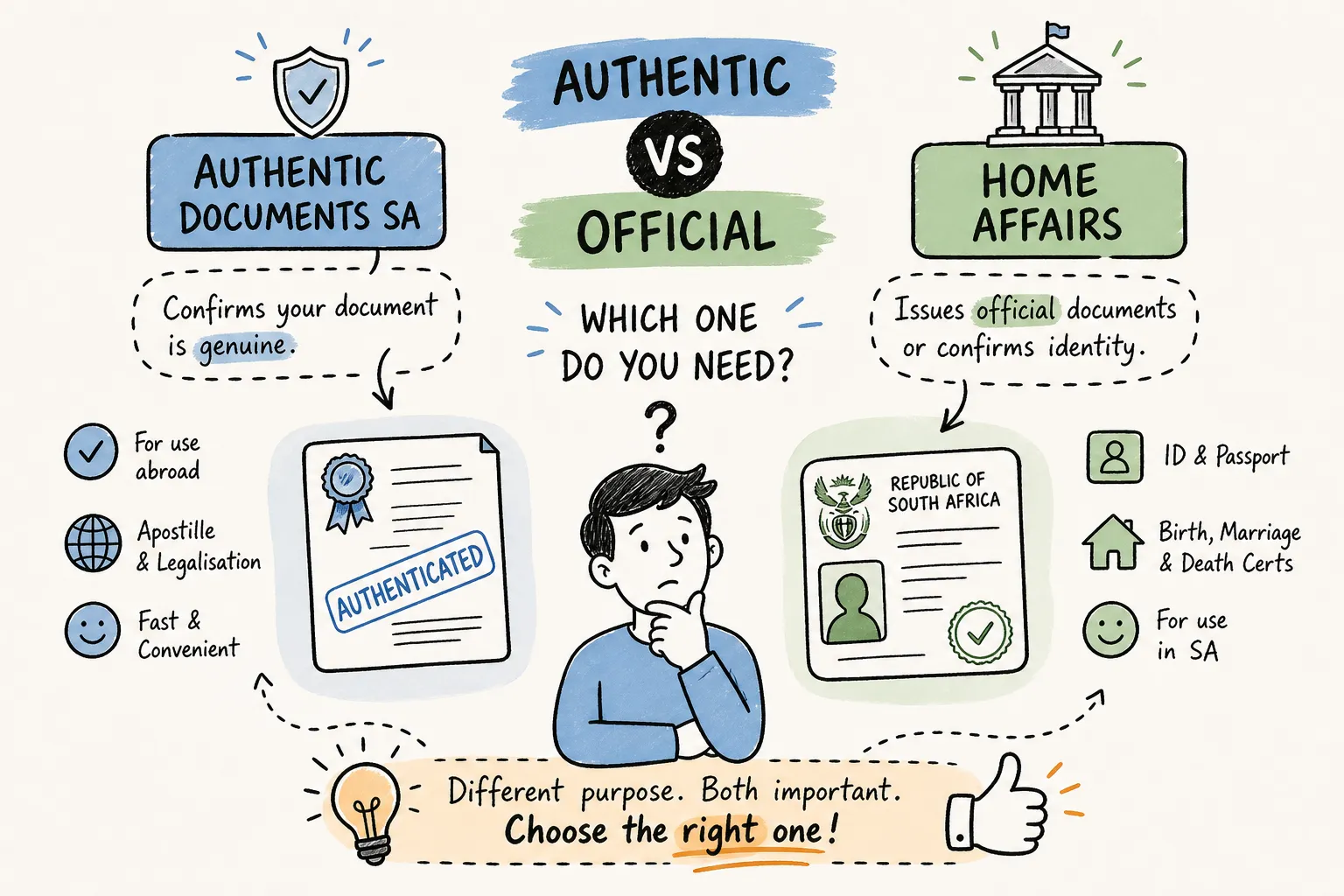
Someone told you to "just get it from Home Affairs" and you assumed that was the end of the story. It isn't. When people search for the difference between Authentic Documents SA and Home Affairs, they're actually asking two separate questions at once: what does the company Authentic Documents SA do, and what does the Department of Home Affairs issue? Both questions matter, and the answer to each shapes whether your document ever gets accepted abroad. According to the company, Authentic Documents SA was built specifically to bridge the gap between what Home Affairs can issue and what international authorities actually require. This article explains exactly where that gap is, how the authentication chain works, and why managing it from overseas without professional support often creates delays, particularly when in-person identity verification or original documents are required.
By the time you finish reading, you'll know which authority handles which step, what "authenticated" actually means versus "certified copy," and what a realistic timeline looks like when you're applying from New York or Los Angeles rather than from a queue in Pretoria.
What Home Affairs actually gives you: originals, certified copies, and where it stops
A common misconception is that a document from Home Affairs is automatically ready for international use. It is not. Home Affairs issues original civil records, including birth certificates, marriage certificates, and identity documents, and it can produce certified copies of documents in its possession. Issuing an apostille or authentication certificate is not part of its mandate. That step belongs to a different authority entirely, and overlooking this reality is where most overseas applications come unstuck.
Original vs certified copy: the difference that matters
An original is the document Home Affairs issued in the first instance. A certified copy is a copy that has been formally declared a true replica by an authorised person, not just any public servant with a stamp. Home Affairs documentation is explicit on this: certified copies must be certified by a person with the correct authority. For most Home Affairs applications, certified copies of original documents are preferred over originals, unless the specific form requests otherwise. Sending original documents unnecessarily can increase the risk of losing them in transit and adds no practical benefit to the process.
When a Home Affairs document is enough and when it isn't
For purely local use, applying for a South African service, updating a record, or presenting identification within South Africa, an original or certified copy from Home Affairs is usually sufficient. For international use, the picture changes entirely. Immigration submissions, employment abroad, study visas, marriage in a foreign country, and USCIS applications all require the document to travel further along the authentication chain. This is the step that catches most people living overseas off guard, and it is where preparation errors cause the most damage.
The full authentication chain: notaries, DIRCO, and what apostille actually means
Most people have heard the word "apostille" but don't know what triggers the need for one, how it differs from legalisation, or where a notary fits in. These are not interchangeable terms. Each represents a distinct step in the chain, and using the wrong one for the wrong document wastes time and money.
Authentication, legalisation, and apostille: not the same thing
Authentication is the core verification of a document's official signature and seal, confirming it is what it purports to be. Legalisation is the broader process of preparing a document for foreign use, which historically required multiple rounds of certification across authorities. An apostille is the shortcut created by the Hague Apostille Convention, which replaces the longer chain of authentication and embassy legalisation steps for countries that are signatories to the Convention, including the United States. South Africa's competent authority for issuing apostilles is DIRCO's Legalisation Section, based at the OR Tambo Building in Pretoria. When you need a South African document accepted in the US, the apostille from DIRCO is the mechanism that makes it legally recognised.
Which documents need a notary before they go to DIRCO
Government-issued civil records, specifically birth and marriage certificates, typically do not require notarisation before apostille. They move from a certified copy directly to DIRCO. Privately created or privately held documents are a different matter. Powers of attorney, affidavits, degree certificates, company documents, and translations almost always require a notary public to certify them first before DIRCO will process them. The practical rule: if the document came from a government department, go directly to DIRCO; if it originated outside government, a notary comes first.
How long DIRCO apostilles actually take in 2026
Turnaround times have increased substantially in recent years. Standard DIRCO apostille processing currently runs between four and eight weeks, with backlog periods extending timelines to eight to twelve weeks or longer. This is not a worst-case scenario; it is the reality for routine applications. For someone managing a visa submission, a university enrolment deadline, or a job start date from the other side of the world, these timelines require early planning and accurate first submissions. There is no margin for errors that restart the process.
What it's actually like trying to do this from overseas
Guides that say "apply online through your nearest embassy" are not wrong, but they skip the part where physical presence, in-person identity verification, and hands-on document handling still feature in many steps. For someone in the United States, the reality of managing a Home Affairs and DIRCO process remotely is considerably more difficult than those guides suggest.
The in-person problem most guides skip over
Many steps in the Home Affairs process require physical presence: submitting applications and verifying identity in particular. Applicants living abroad can submit through South African embassies or consulates, but the mission then forwards the application to Home Affairs in Pretoria for processing. The application still sits in the same queue, the same backlog, the same system. For some document types, original documents or fingerprint verification are required, which creates additional complexity for clients who cannot present themselves in person.
Wait times and what "processing time" means in practice
Home Affairs processing backlogs are well documented. Official processing time estimates for unabridged birth certificates, marriage certificates, and identity documents run from six to nine months. DIRCO's apostille processing adds a further four to twelve weeks on top of that. A document application that should be straightforward can extend significantly if submitted with an error, a missing requirement, or incorrect certification. For someone managing an immigration application with a real deadline, each stage of delay compounds the next.
Why rejection hits harder from abroad
Common rejection causes include incorrect certified copies, missing supporting documents, wrong document versions, and forms completed in ways that don't match current requirements. From overseas, each rejection doesn't just cost time, it restarts the chain from whatever step failed. The client must make contact again, prepare fresh documentation, resubmit, and wait again. Given that Home Affairs processing alone can run six to nine months, a single rejection that adds one further cycle has serious downstream consequences for visa timelines, employment contracts, and legal proceedings.
Authentic Documents SA vs Home Affairs: what the company manages on your behalf
Authentic Documents SA positions itself as a service built specifically for clients who cannot queue at a Home Affairs office or hand-deliver documents to DIRCO in Pretoria. The stated service model is end-to-end case management: one point of contact, accurate preparation before submission, tracking through each stage of the process, and secure worldwide courier delivery of completed documents to the client's address abroad. The company markets itself as a specialist operation focused on South African official documents rather than a generic document courier service.
End-to-end case management: what this actually looks like
According to the company's stated services, the process covers the full chain. Authentic Documents SA handles Home Affairs applications from the outset, coordinates notarial authentication where the document type requires it, submits to DIRCO for apostille, tracks progress through each stage, and arranges secure international delivery. The client receives updates throughout without needing to chase individual government departments or manage conflicting requirements across multiple authorities. For South Africans in the United States who need documents accepted by USCIS, an immigration attorney, an employer, or a university, this kind of structured approach aims to reduce the preparation errors that cause most rejections.
The specific documents they handle and why specialist knowledge matters
The company's listed services include police clearance certificates, unabridged birth and marriage certificates, DIRCO apostilles, Letters of No Impediment, retention of citizenship applications, notary public services, and driver's licence confirmation letters. This focus matters because the requirements, timelines, and submission protocols for each document type change regularly. Specialist providers who work exclusively in this field are more likely to be current on South African requirements than a generalist courier or a domestic law firm without dedicated document expertise. Incorrect submissions create exactly the rejection risk described above, and the client absorbs those consequences.
Fees, realistic timelines, and how to identify a trustworthy service
DIRCO itself does not charge a fee for issuing an apostille certificate. The real costs in professional document assistance are the service fee for case management, notary fees where applicable, and courier charges for international delivery. When you weigh that against the alternative, an international flight to South Africa, potential missed work, and the cost of a failed application that needs to restart from scratch, professional assistance represents clear value for most overseas clients.
What to budget and how long to plan for
Private service provider fees for DIRCO apostille processing in South Africa currently range from approximately R850 to R1,650 per document, depending on the provider and whether courier and handling are included. This covers the professional assistance component; the DIRCO government fee itself is not charged. From a timeline perspective, planning requirements vary by document type. For documents that require Home Affairs processing, budgeting six to nine months for that stage alone is realistic, with DIRCO apostille adding a further four to twelve weeks and international courier delivery on top of that. Some document types move faster; the point is that applications with firm deadlines require early action.
Red flags that signal an unreliable or scam service
Several warning signs are worth knowing before you commit to any service. Be cautious of providers that guarantee turnaround times faster than DIRCO's current processing periods. Watch for services with no verifiable physical address or contact details, and avoid any service requesting full payment upfront without a formal service agreement. Legitimate services can name the specific South African legislation and government departments relevant to your document type, demonstrate active knowledge of current DIRCO and Home Affairs requirements, and give you a realistic timeline based on what the process actually involves in 2026, not what it looked like three years ago.
The Authentic Documents SA vs Home Affairs distinction in plain terms
Home Affairs issues the foundational documents. A notary and DIRCO enter the chain when those documents need to be recognised internationally. Managing that chain from abroad without professional support creates real risk of delay, rejection, and missed deadlines. These are not hypothetical risks, they are the practical outcomes that result from incorrect submissions, misunderstood requirements, and processes that were designed for in-person applicants in South Africa, not for South Africans living in the United States.
The difference between Authentic Documents SA and Home Affairs isn't a competition between two alternatives. Home Affairs is the source of the documents. Authentic Documents SA is the professional support designed to help those documents reach international acceptance from 15,000 kilometres away. Many South Africans abroad face exactly this situation: a document is needed urgently, the process is unclear, and flying back is not realistic.
If you need a South African document authenticated, apostilled, or prepared for international use, contact Authentic Documents SA to find out exactly what the process looks like for your specific document type and how long you should realistically allow.