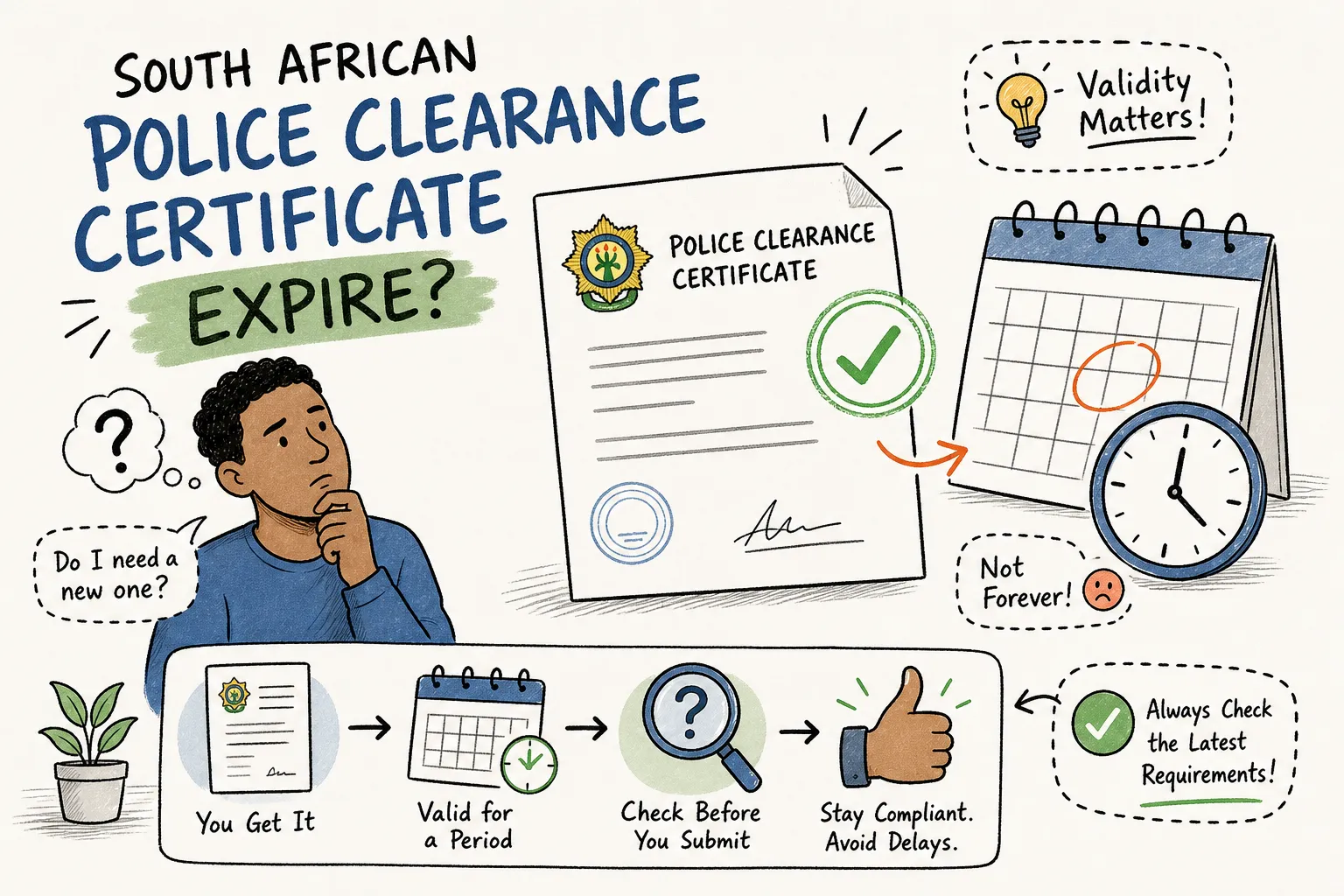
Do South African Police Clearance Certificates Expire?
Do South African police clearance certificates expire? It is one of the most common questions South Africans abroad face when a visa deadline looms or a new employer asks for paperwork. The short answer is that SAPS does not print an expiry date on the certificate itself, and South African legislation does not give police clearance certificates a statutory shelf life. The longer answer is that many institutions, embassies, and employers that ask for one enforce their own acceptance window, and that window is commonly six months from the date of issue.
The practical consequence matters enormously. A certificate that is technically valid from SAPS's perspective can be flatly rejected by a UK visa office, a SACE registration portal, or a US-based employer purely because of how old it is. South Africans living abroad face an added layer of pressure: not only does the certificate age from the moment SAPS issues it, but arranging a fresh one from overseas takes time that many people underestimate. Third-party reports indicate that real-world processing commonly runs six to eight weeks, far longer than the official 14 working days.
Understanding the two-part reality of certificate "expiry" gives you the clarity you need to plan properly and avoid losing weeks of processing time to a technicality. So, do South African police clearance certificates expire in any formal sense? No. But do they become practically unusable after a certain point? For most immigration, registration, and legalisation purposes, yes.
What SAPS actually prints on your certificate
South African legislation does not assign a formal expiry date to a police clearance certificate, and the certificate itself carries no such notation. What SAPS prints is a date of issue. The certificate records your criminal history as it stood on the day SAPS ran the check against the Criminal Record Centre's database. That record does not self-destruct after a fixed period in any legal sense.
This distinction matters because it separates legal reality from institutional reality. The six-month window that most people associate with a South African PCC is not a SAPS rule. It originates entirely from the policies of the institutions that receive the certificate. DIRCO's own legalisation office states that original police clearance certificates older than six months from the date of issue will not be accepted for authentication purposes. Many foreign embassies, registration bodies, and employers have adopted a similar standard. The six-month window is a downstream acceptance rule enforced at the receiving end, not a validity date set by SAPS at the point of issue.
Because no renewal stamp or extension mechanism exists, the issue date printed on your certificate is the single reference point every institution uses to calculate freshness. Once your PCC is issued, the clock starts immediately. One additional point worth knowing: SAPS will destroy certificates not collected within three months of finalisation, so uncollected certificates create their own timing problem before the six-month acceptance window even becomes relevant.
Do South African police clearance certificates expire for visa and registration purposes?
This is where the practical answer diverges sharply from the legal one. The UK Home Office explicitly states that a South African police clearance certificate is valid for six months only from the date of issue. Australia, Canada, and New Zealand apply the same standard for visa and permanent residency applications. Each of these countries requires a PCC from applicants who lived in South Africa for six months or longer since the age of 18, and all of them will reject a certificate that falls outside the acceptance window regardless of its content.
The United States also requires a South African police certificate as part of certain immigration processes. While the six-month rule commonly applies in practice, applicants should confirm the specific requirement directly with USCIS or the State Department, or consult an immigration attorney, as the available guidance does not explicitly codify a fixed window in the same way as UK or Australian instructions.
How long is a South African PCC valid for SACE and local employers?
For teachers and education professionals, the South African Council for Educators is unambiguous: a PCC submitted for registration, renewal, or a letter of good standing must be no older than six months at the time of submission. This requirement applies at every stage of the SACE process, which means planning your application around the SACE submission deadline is essential. Many teachers make the mistake of applying for a PCC and then delaying the SACE submission, only to find the certificate has aged past the acceptance window before they get around to it.
Many South African employers in finance, healthcare, and education apply the same six-month standard. Some security-sensitive roles, particularly in the private security and financial services sectors, require a PCC no older than three months, though this varies by employer and role. Treat three to six months as your operating window in any formal employment or vetting process, and apply for a fresh certificate the moment you receive a conditional offer, not when onboarding paperwork arrives.
Does apostilling your PCC change how long it stays accepted?
This is a common point of confusion. An apostille is a form of authentication that verifies the origin of a document and the legitimacy of the official signatures on it. It confirms to a foreign authority that your certificate is genuine. It does not alter the content of the certificate, and it does not reset or pause the age of the document.
DIRCO's guidance on this is clear: it will not apostille a police clearance certificate that is older than six months from the date of issue. This means the entire apostille process must happen while the certificate is still within its acceptance window. If you wait until you are four months past the issue date before approaching DIRCO, you have a very narrow runway to complete apostille authentication and deliver the certificate to the receiving institution while it still counts.
The practical timing sequence is straightforward. Obtain your SAPS certificate, then submit it for apostille authentication promptly. A certificate apostilled at month two has a far better chance of reaching a recipient within their acceptance window than one apostilled at month five. The apostille authenticates the document's origin; the issue date still governs its acceptance. Do not assume that the apostille stamp adds any buffer to the age calculation.
When your certificate is too old: the reissue and new application process
SAPS distinguishes between a reissue and a new application based on how much time has passed since your original application date. If you apply for a reissue within six months of the original application date, SAPS will process it as a reissue. Beyond six months, you must submit a full new application with a fresh set of fingerprints and updated certified documentation. SAPS policy specifies that the six-month reissue window is firm, confirm the current wording directly with SAPS before submitting, as policy details can change.
A new SAPS police clearance application requires a completed application form, a full set of ink fingerprints taken by an authorised officer, and a certified copy of your South African ID or passport. The current official SAPS application fee is R190. Earlier figures of R59 and R114 appear in older guides and do not reflect the current tariff, so confirm the fee directly with SAPS before submitting to avoid delays caused by incorrect payment.
The official SAPS processing time is 14 working days from receipt of a complete application at the Criminal Record Centre in Pretoria. In practice, third-party reports indicate that real-world turnaround regularly runs six to eight weeks, and during periods of high application volume it can stretch to three months or more. If a visa deadline, SACE renewal, or employment start date is on the horizon, apply at least two months in advance. Building in additional buffer if you are applying from outside South Africa is equally important.
How South African expats can renew their PCC from anywhere in the world
Renewing a SAPS police clearance certificate from outside South Africa is manageable, but it requires co-ordinating several steps simultaneously. You need an authorised ink fingerprint capture, typically done at a local police department or a certified fingerprinting bureau in your country of residence. SAPS accepts fingerprints taken on the official fingerprint forms of your country of residence, or on the SAPS 91(a) fingerprint enquiry form where that form is available. SAPS guidance and most embassy instructions indicate that digital fingerprints are not accepted, though it is worth confirming this with SAPS or your nearest South African embassy before you proceed.
Once your prints are captured, the full application package, including the fingerprint form, certified ID documentation, and the completed SAPS application form, must be routed to the Criminal Record Centre in Pretoria. You then need to arrange secure return delivery once the certificate is issued, which adds further lead time. If apostille authentication is also required, that step must happen before the certificate exceeds its six-month window, which means the entire sequence needs to be planned carefully from the start.
This is precisely the kind of multi-step, cross-border process that Authentic Documents SA assists South African expats with. The service includes guidance on the correct fingerprint capture format in your country of residence, assistance with routing your application to SAPS, monitoring progress, co-ordinating DIRCO apostille authentication where required, and arranging worldwide courier delivery of the completed certificate. For South Africans managing USCIS requirements, employment vetting, or SACE renewals from abroad, having a dedicated case manager track the certificate's issue date and flag the renewal window before it closes can make a meaningful difference when timelines are tight.
The two facts worth remembering, and what to do next
South African police clearance certificates carry no official expiry date issued by SAPS and no statutory shelf life established in South African legislation. That is the legal reality. The practical reality is that a certificate older than six months from its issue date is effectively unusable for most common immigration, registration, and legalisation purposes a South African expat or visa applicant would need it for, whether that is a UK or Australian residency application, SACE registration, employment screening, or DIRCO apostille authentication.
So, do South African police clearance certificates expire? Not in law, but they become practically redundant for most purposes once they pass the six-month mark. The smart approach is to treat six months as a hard deadline and work backwards from your submission date to determine when to apply.
Quick action points
- Check the issue date on your current certificate and calculate how much of the six-month window remains.
- Allow for SAPS processing time of at least six to eight weeks (longer during peak periods), not the official 14 working days.
- Submit for DIRCO apostille authentication well before the certificate reaches the five-month mark if legalisation is required.
- If applying from abroad, confirm fingerprint capture requirements with your nearest South African embassy or consulate before proceeding.
- Schedule courier delivery so the certificate arrives at the receiving institution while it still falls within the acceptance window.
If you are managing this process from abroad, across time zones and multiple government departments, the risk of missing the acceptance window is real but avoidable. Authentic Documents SA helps remove that risk by handling your SAPS police clearance application, apostille authentication where needed, and worldwide courier delivery, so the right document reaches the right place while it still counts. Reach out to discuss your specific timeline and we will map out exactly what needs to happen and when.