How to Get a South African Police Clearance for Ireland Visa 2026
If you are applying for an Irish visa or immigration status and South Africa appears on your residential history, you will need a South African police clearance certificate for your Ireland visa or immigration application. This 2026 guide covers exactly how to get it done: the documents SAPS requires, how to get your fingerprints taken correctly from abroad, the DIRCO apostille step that Ireland specifically requires, realistic timelines, and the overseas application pathway in full. The South African PCC process has several specific procedural steps, ink fingerprints taken in person, a paper application, a courier journey to Pretoria, and a separate authentication step, that overseas applicants must follow precisely. There is no shortcut, and there is no digital submission route.
The good news is that this process is entirely manageable once you understand the correct sequence. For South Africans already living in the US or Ireland, specialist services like Authentic Documents SA exist precisely to manage this workflow remotely, so there is no need to fly back to South Africa to get it done. Read on for the complete step-by-step breakdown.
What SAPS requires before they will issue your police clearance certificate
The core document checklist for your South African PCC application
The SAPS Criminal Record Centre (CRC) in Pretoria processes all police clearance certificate applications and has a fixed list of requirements. Before anything reaches Pretoria, your application pack must include five things: a duly completed application form, a full set of fingerprints on the SAPS 91(a) form, a certified copy of your identity document or passport, proof of payment of the prescribed fee, and documentary proof of any additional surnames that must appear on the certificate.
Every single one of these items is non-negotiable. The CRC will not process an incomplete application, and applications received from abroad are not returned to the applicant. If your pack arrives missing a document, it stalls and you start again.
Why a certified copy is not the same as a photocopy
SAPS requires a certified copy of your identity document or passport, meaning the copy must bear the stamp and signature of a commissioner of oaths or a SAPS officer. A plain colour scan or photocopy will not be accepted. For applicants outside South Africa, the equivalent is a copy certified by a notary public or a local police officer, depending on the country. This step is frequently skipped or done incorrectly by overseas applicants, and it is one of the most common reasons applications are delayed.
When you need additional name documentation
If your current surname differs from your birth surname, SAPS requires documentary proof to connect the two. A certified copy of your marriage certificate is the standard supporting document in this situation. For Ireland-bound applications, this is not a minor detail, the name on your PCC must align exactly with the name on your passport. Irish immigration authorities will generally expect the name on the PCC to match your travel documents; if there is a discrepancy, confirm the specific requirement with INIS for your visa category before submitting.
How to get your fingerprints done correctly for a South African police clearance certificate
Taking fingerprints inside South Africa
For applicants currently in South Africa, fingerprints must be taken by the South African Police Service at any SAPS police station or service centre. You present your identity document, and the SAPS 91(a) form is completed with a full set of rolled ink prints. Many SAPS stations accept walk-ins, but availability varies by station and time of day, check locally beforehand.
Taking fingerprints outside South Africa
SAPS officially allows two options for overseas applicants: any police station in the country where you currently reside, or a South African Embassy or Consulate. Either the SAPS 91(a) form or the official fingerprint form of the host country is acceptable. For South Africans in the US, the local sheriff's office or a municipal police department can take fingerprints on a standard fingerprint card, confirm with the station in advance that they can take rolled ink fingerprints on a provided form, as not all US law enforcement offices are familiar with this format.
South African missions abroad, including embassies and consulates, are listed under SAPS guidance as an option for the fingerprint stage. Contact your nearest South African mission directly to confirm current services and appointment availability before relying on this route, as offerings vary by location.
Where the fingerprint pack goes after submission
The completed fingerprint form and all supporting documents must be physically sent to the SAPS CRC in Pretoria by courier or post. This is not submitted digitally or via email. The physical pack travels to Pretoria, which has direct implications for the timelines covered in the next section. Do not send originals of your identity document. Send certified copies only, because SAPS will not return submitted materials.
Why Ireland specifically requires an apostille on your South African PCC
Ireland's document authentication rules and the Hague Convention
Both South Africa and Ireland are signatories to the Hague Apostille Convention. This means South African documents intended for use in Ireland must carry a DIRCO (Department of International Relations and Cooperation) apostille to be legally recognised. Irish immigration authorities, including the Irish Immigration Service Delivery (ISD) and the Irish Naturalisation and Immigration Service (INIS), commonly expect an apostilled foreign police clearance as the correctly authenticated version of the document. Applicants should verify the specific requirement with INIS or check their visa guidance, but submitting an unapostilled PCC directly to Irish authorities is one of the most common errors applicants make and typically results in the document being returned.
The correct sequence: PCC first, then DIRCO apostille
The order of operations here is fixed and cannot be reversed. SAPS issues the original PCC first. Once you have the original PCC in hand, it goes to DIRCO's Legalisation Section in Pretoria for the apostille to be affixed. You cannot apostille a document that does not yet exist, and trying to run both stages simultaneously is not possible. Each stage has its own processing window, and both must be completed before the document is usable in Ireland.
How to submit to DIRCO for the apostille on your criminal record check
Documents are submitted to DIRCO in Pretoria either in person through a nominated representative or via courier. DIRCO does not charge for the apostille itself. Turnaround ranges from same-day for five or fewer documents submitted in person to three to four weeks for courier submissions. For overseas applicants who cannot present documents in person, a local representative or agency handling both the SAPS and DIRCO stages within South Africa is the practical route. Authentic Documents SA provides this end-to-end service: collecting the PCC from SAPS and walking it through DIRCO's Legalisation Section in Pretoria before couriering the final apostilled document internationally.
Realistic timelines and costs to build into your PCC for Ireland visa 2026 application
How long SAPS CRC takes to process a PCC application
The official SAPS target is 14 working days from the date a complete application is received at the CRC. Government-adjacent guidance sometimes quotes six to eight weeks as a more conservative estimate, and non-official reports from service providers place real-world timelines anywhere between four and twelve weeks, particularly when there are backlogs. There is no expedited lane for PCC applications. If your fingerprint card is rejected due to poor print quality or missing documentation, the clock restarts from the date a corrected submission is received.
DIRCO apostille processing and fees
DIRCO's apostille service carries no government fee when submitted directly. The turnaround for courier-submitted documents is three to four weeks; walk-in submissions handled by a registered representative can be processed considerably faster. Specialist agencies managing this on your behalf charge a service fee for their handling, which varies by provider. Budget separately for outbound and return courier costs, as these are not included in any government fee.
What total timeline to plan for
For South Africans abroad, the consolidated planning window from first submission to receiving an apostilled PCC is a minimum of six to twelve weeks. This accounts for fingerprint booking, courier transit to Pretoria, SAPS CRC processing, DIRCO apostille turnaround, and international courier return. Start this process well before your Irish visa appointment or immigration deadline. SAPS processing does not bend for external deadlines, and Irish immigration timelines are fixed.
How to apply for your South African PCC for an Ireland visa from abroad
The overseas application pathway SAPS officially allows
SAPS explicitly allows overseas applicants to send their full application pack to the CRC in Pretoria by courier. There is no obligation to route through a South African embassy, though the embassy fingerprint service remains an option for the fingerprint stage. The pack should contain the completed application form, the fingerprint card, a certified copy of your identity document or passport, supporting surname documentation if applicable, and proof of payment. Certified copies only, submitted documents are not returned.
Courier logistics and the collection challenge
The full pack travels outbound to Pretoria by courier. Once the PCC is ready, SAPS releases it only to the person nominated on the application or to a chosen courier service. This means you must arrange a South African address, a nominated person, or a local agency in Pretoria to collect the PCC once it is issued. That collected PCC then needs to travel to DIRCO for apostille before being couriered internationally to you. Without someone physically present in Pretoria to manage both the SAPS collection and the DIRCO submission, the process requires careful coordination from abroad.
How a specialist service removes the complexity
This multi-step coordination is where overseas applicants most frequently hit delays or make errors. Authentic Documents SA is built specifically for this workflow. The service manages your SAPS application submission, handles courier collection in Pretoria, coordinates the DIRCO apostille stage, and arranges final international delivery in one end-to-end process. For South Africans living in the US or elsewhere outside South Africa, this means the entire PCC and apostille process is handled remotely, no flights required and no SAPS police station visits to navigate from thousands of miles away.
Mistakes that get PCC applications rejected or delayed
Name discrepancies between your PCC and your Irish visa documents
The name on your police clearance certificate must match your passport exactly. If you have changed your surname through marriage or deed poll, you need the correct supporting documents submitted to SAPS at the time of application, and your Irish immigration file must include a document trail connecting the two names. Irish immigration will generally expect the name on the PCC to match your travel documents, confirm the specific requirement with INIS for your visa category. Sorting name documentation before submission is far easier than trying to correct it after the fact.
Smudged or incomplete fingerprints
Poor fingerprint quality is one of the most common reasons CRC processing stalls. SAPS will reject a fingerprint card with smudged, incorrectly rolled, or incomplete prints, and the application does not move forward until a corrected card is received. Overseas applicants using a local police station that is unfamiliar with the SAPS 91(a) format are especially at risk here. Before leaving the station, check each finger's impression carefully and ask the officer to re-roll any that appear smudged or faint. It is far easier to redo two fingers on the spot than to courier a fresh card back to South Africa weeks later.
Submitting without an apostille, or apostilling the wrong document version
Some applicants send a copy of their PCC to DIRCO rather than the original issued certificate. Others submit a laminated copy, which DIRCO will not apostille. DIRCO apostilles original documents only. A separate and equally common error is sending an unapostilled PCC directly to Irish authorities, which gets returned. The sequence is fixed: original PCC from SAPS, apostille from DIRCO, then courier to Ireland. Skipping or reversing any step means starting that stage again.
Get the sequence right and start early
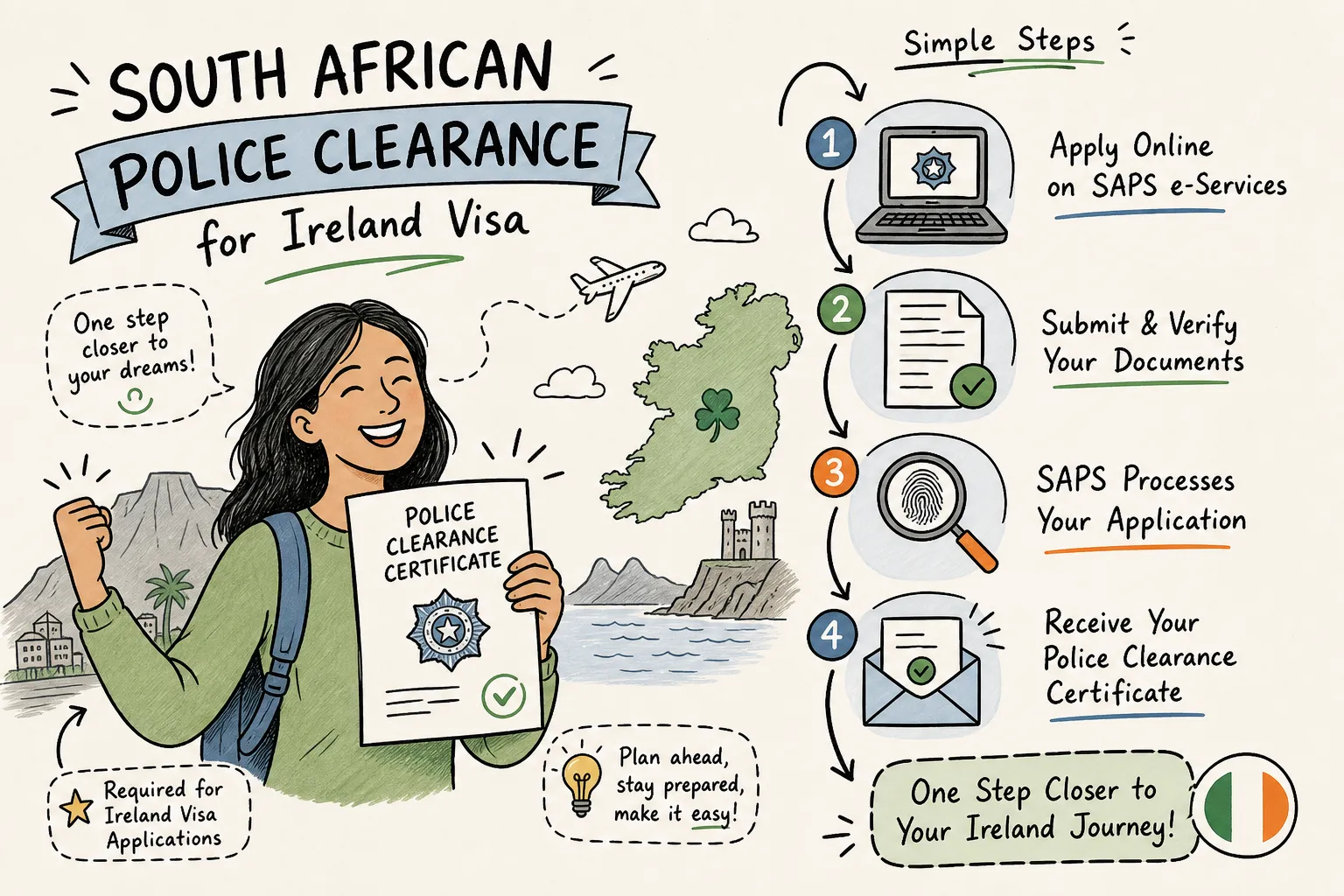
The full workflow runs in one direction: prepare your documents and get fingerprints done correctly, submit to SAPS CRC, receive the original PCC, take it to DIRCO for the apostille, then courier the apostilled certificate to Ireland. Each stage feeds directly into the next, and none of them can be rushed on demand.
The biggest risk in this process is time. Ireland visa and immigration timelines are fixed, and SAPS processing does not adjust for external deadlines. A six-to-twelve-week planning window is not a worst-case estimate; it is a realistic baseline for overseas applicants, and any errors along the way extend it further. Start earlier than you think you need to.
This guide covers the complete South African police clearance certificate process for Ireland visa and immigration applications, the 2026 requirements remain as described above, with no digital shortcut available. If you are based in the US or anywhere outside South Africa and need to get this done without returning home, Authentic Documents SA handles the entire process: SAPS application submission, Pretoria coordination, DIRCO apostille, and international delivery. Contact our team to open your case and confirm your timeline well ahead of your Irish immigration deadline.
Why Use a Professional Assistance Service?
Many applicants prefer expert help because it can reduce delays, confusion, and repeated follow-ups.
Authentic Documents SA assists clients locally and internationally with document applications and secure courier options.
Police clearance certificate South Africa
Need Help?
If you need assistance with a Police Clearance Certificate in South Africa, contact Authentic Documents SA for professional support.
https://www.authenticdocumentssa.co.za