How to Get SA Police Clearance for Netherlands Visa 2026
This South African police clearance certificate for Netherlands visa immigration applications 2026 guide covers the exact document Dutch authorities accept, the complete SAPS application process, the apostille requirement, realistic timelines, and the mistakes that derail applications before they reach the IND. Applying for a Netherlands visa or residence permit as a South African means navigating two separate bureaucracies simultaneously: the Dutch immigration system and the South African Police Service. Many applicants encounter delays because of strict document requirements, and the wrong document can push an application back by months. The fingerprint requirement alone catches people off guard, and the six-month validity window creates a timing puzzle that needs careful planning from the start.
Whether you are applying from inside South Africa or managing everything remotely from the United States, the process follows the same rules, but the logistics are very different. Services like Authentic Documents SA exist precisely for this reason: to handle the SAPS side of things so applicants can focus on the Dutch side without losing track of what is happening in Pretoria.
What the Netherlands immigration authorities require from South African applicants
The Netherlands does not accept a name-and-date-of-birth police report. Dutch immigration authorities require an original fingerprinted SAPS Police Clearance Certificate issued by the SAPS Criminal Record Centre in Pretoria. This distinction matters enormously: applicants who arrive with the wrong document type face immediate rejection and have to restart a process that can take months. The certificate must be an original; scans and photocopies are not accepted.
Your SAPS PCC must be no older than six months at the time you submit your Netherlands visa or residence permit application. Because SAPS processing regularly takes several months in practice, you need to time your application carefully so the certificate does not expire before your submission date. Build your timeline backwards from your intended Dutch submission date rather than forwards from when you plan to start.
The Netherlands requires a police certificate from every country where you lived for 12 months or longer after the age of 18. If you have spent time in multiple countries, you need certificates from each of them. For South Africa specifically, the SAPS PCC covers your full South African criminal record history regardless of how long ago you left the country. The IND (Immigration and Naturalisation Service) applies this requirement consistently; confirm any exceptional circumstances directly with the IND or check your specific visa checklist.
It is worth noting that the Netherlands issues its own equivalent document, the Verklaring Omtrent het Gedrag (VOG), or Certificate of Good Conduct, for residents in the Netherlands. The VOG is a domestic Dutch record check and does not replace the SAPS PCC. South African applicants must provide the SAPS PCC to satisfy the foreign-country police certificate requirement; the VOG is a separate, Dutch-side document that may be required for employment or other purposes once you are in the Netherlands.
South African police clearance certificate for Netherlands visa applications, step-by-step (2026)
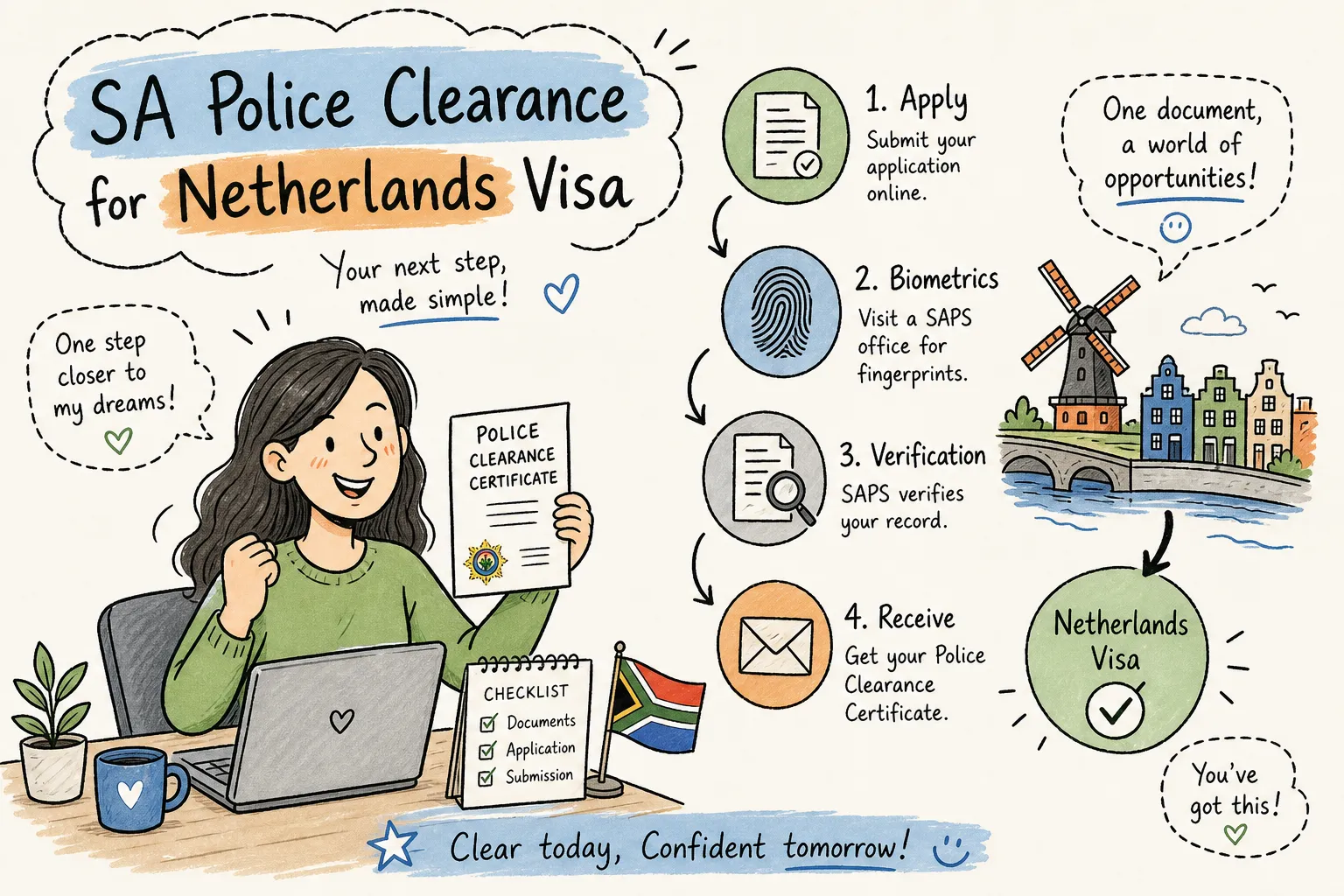
The core application pack consists of a completed application form, a full set of fingerprints captured on the SAPS 91(a) form, a certified copy of your South African ID or passport, and proof of payment of the R190 application fee. If your surname has changed, attach supporting documents such as a marriage certificate. Incomplete applications may remain unprocessed until the gap is corrected, so verify every item against the official SAPS requirements before you submit.
Inside South Africa, fingerprints must be taken at a SAPS station, which then forwards the complete application to the SAPS Criminal Record Centre in Pretoria. The quality of the impression matters: rolled prints must be complete and clear, because a poor impression causes automatic delays at the Criminal Record Centre.
If you are abroad, fingerprints can be taken at a local police station or a South African Embassy or consulate using the official SAPS 91(a) form. For South Africans in the United States, the South African consulates in Los Angeles and New York offer fingerprinting directly onto the SAPS form and are worth confirming with the relevant consulate for current availability. Local law enforcement agencies or sheriff's offices that offer ink fingerprinting are an alternative, though quality control varies.
Once your pack is complete, it is submitted to the SAPS CRC in Pretoria by your local station, in person, by post, or by courier. SAPS does not operate an online submission portal for this application. Keep your proof of submission: tracking your application at the CRC requires a reference number, and follow-up by phone or in person is often the most reliable way to confirm receipt and check progress.
Documents checklist
- Completed SAPS application form
- Fingerprints on the SAPS 91(a) form (rolled, complete, and clear)
- Certified copy of your South African ID or passport
- Proof of payment of the R190 fee
- Supporting name-change documents if applicable (e.g. marriage certificate)
Apostille & validity for your South African police clearance certificate for Netherlands immigration
The Netherlands is a signatory to the Hague Apostille Convention, which means South African documents for use in the Netherlands are authenticated via an apostille rather than through the Dutch embassy. Without this apostille, your SAPS PCC has no formal legal standing in the Netherlands. Embassy legalisation applies only to countries outside the Hague Convention, so do not confuse the two processes.
The authority that issues apostilles on South African government documents is DIRCO (the Department of International Relations and Cooperation), through its Legalisation Section at the OR Tambo Building on Soutpansberg Road in Rietondale, Pretoria. The DIRCO apostille is affixed directly to the original SAPS PCC, and counter collection hours run from 08:30 to 12:15 daily except Wednesdays.
Counter-service applications submitted early in the day can be ready the same day or the following working day. The standard DIRCO apostille route takes approximately seven to fourteen working days. If timing is tight, a High Court apostille is an alternative route with a faster turnaround of one to three working days.
South African police clearance certificates are issued in English, and the Netherlands accepts documents in English without translation. The IND's language rule is clear: only documents not in Dutch, English, French, or German require a sworn translation, so a standard SAPS PCC needs no certified translation.
Realistic timelines and costs to plan for in 2026
The official SAPS turnaround is six to eight weeks from receipt of a complete application. In practice, 2026 reports indicate that backlogs at the Criminal Record Centre regularly push waiting times to three to six months. Peak submission periods (December to January and June to July) can add four to six additional weeks on top of normal processing. Submitting a flawless application pack the first time is the single most effective way to avoid extended delays.
Peak season timing
February through May and August through November tend to produce shorter turnaround times. If your Netherlands application timeline allows flexibility, scheduling your SAPS submission outside peak periods is a practical way to reduce risk.
Once you hold the original SAPS PCC, the DIRCO apostille adds approximately seven to fourteen working days. The SAPS application fee is R190, which is non-refundable and must accompany every submission. DIRCO's counter apostille service is understood to carry no government charge at the time of writing; confirm current fees directly with the DIRCO Legalisation Section before you submit, as charges can change.
Working backwards from your Netherlands application deadline: allow at least three months for the SAPS PCC under normal conditions, then add two weeks for the DIRCO apostille. A conservative total from first submission to apostilled PCC in hand is fourteen to eighteen weeks. Start the process as early as possible, because the validity clock starts from the SAPS issue date, not from the date you receive the document, delivery can lag the issue date by days or weeks depending on how it is arranged. Confirm the exact counting method with the IND or your VFS Global application centre if you are close to the six-month limit.
Common mistakes that delay or derail SA police clearances
The most common and most avoidable mistake is submitting a name-and-date-of-birth check instead of the fingerprinted SAPS PCC. Dutch immigration is explicit: only the fingerprinted original is accepted. Confirm with the IND or your visa application centre before you invest months obtaining the wrong document. This error is entirely preventable with a single verification step at the start.
A PCC that is more than six months old at the point of submission will be rejected outright, which means restarting the entire process. This happens most often when applicants apply for the PCC too early and then face delays on the Dutch side, or when SAPS processing takes longer than expected. Time your SAPS application as close to your realistic Dutch submission window as possible rather than applying at the earliest opportunity.
SAPS will not process an application where fingerprint impressions are too faint, smudged, or incomplete. Similarly, a missing certified ID copy or absent proof of payment means the application sits unprocessed until the gap is corrected. Checking every item against the SAPS requirements before you seal the envelope is the most effective safeguard against avoidable delays.
Managing the SAPS process remotely from the United States
SAPS offices operate on in-person logic: fingerprinting, certified copies, physical submission, and in-person follow-up. For South Africans living in the US, each of these steps requires either a trip back to South Africa or careful coordination through the South African embassy, which carries its own appointment backlogs. An error in a remotely assembled application pack can add significant delay to your wait, based on reported turnaround ranges of three to six months, even a single correction cycle can be costly to a carefully timed visa application.
This is where a specialist service like Authentic Documents SA removes the bureaucratic burden. As specialists in South African government documents, they manage the full SAPS PCC process on your behalf: guiding you through fingerprint capture abroad, preparing and checking your application pack, submitting to the SAPS Criminal Record Centre, tracking progress, and moving the certificate through the DIRCO apostille stage once it is issued. Everything is handled remotely, with secure worldwide courier delivery to your US address. For applicants on a Netherlands immigration timeline, that end-to-end management reduces the risk of errors that only surface after weeks of waiting.
Summary: your South African police clearance certificate for Netherlands visa immigration applications
Use this South African police clearance certificate for Netherlands visa immigration applications 2026 guide to plan your timing and avoid the delays that catch applicants off guard. The IND wants the fingerprinted SAPS PCC, issued within the last six months, apostilled by DIRCO, in English with no translation needed. The process is manageable but slow in practice: allow that fourteen-to-eighteen-week window from first submission to apostilled certificate in hand, avoid peak application periods where possible, and submit a complete, error-free pack from day one.
If you are managing this from abroad, starting early and knowing exactly what the Dutch authorities require is non-negotiable. Whether you handle the process yourself or work with Authentic Documents SA to manage it remotely, the key is leaving no room for preventable errors. Contact Authentic Documents SA to find out how their document assistance service can take the SAPS process off your plate.
Why Use a Professional Assistance Service?
Many applicants prefer expert help because it can reduce delays, confusion, and repeated follow-ups.
Authentic Documents SA assists clients locally and internationally with document applications and secure courier options.
Police clearance certificate South Africa
Need Help?
If you need assistance with a Police Clearance Certificate in South Africa, contact Authentic Documents SA for professional support.
https://www.authenticdocumentssa.co.za