How to Get a South African Police Clearance for NZ Visa 2026
You open your Immigration New Zealand checklist, scroll down, and there it is: "Police certificate from South Africa." No further explanation. No link to a form. No acknowledgement that you are sitting in Auckland, thousands of kilometres from the nearest SAPS police station. That single line can feel like a full stop on your visa plans, but it does not have to be.
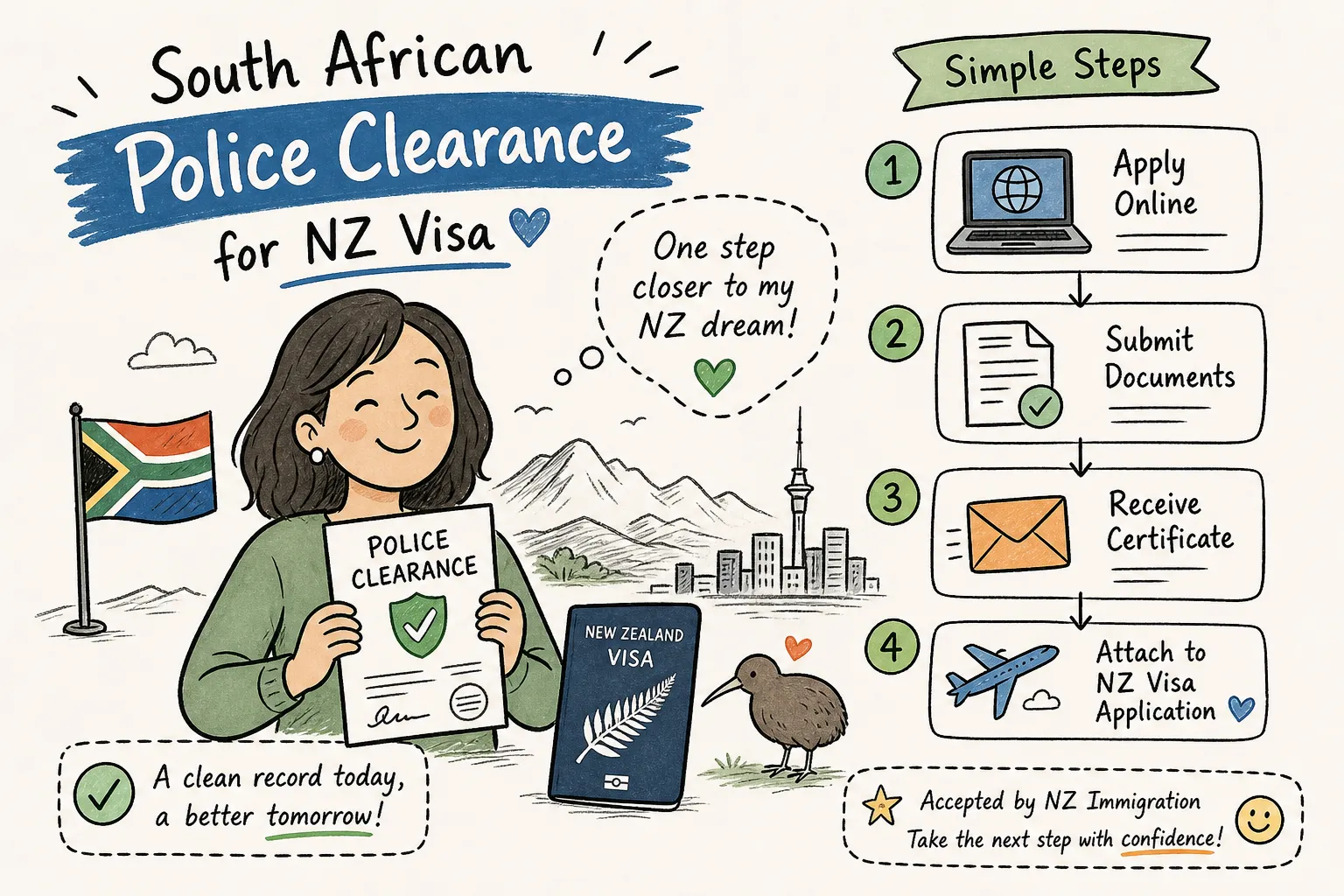
This guide covers the full South African police clearance certificate process for New Zealand visa and immigration applications in 2026: from confirming whether INZ actually needs your certificate, through fingerprinting options, fees, timelines, and the apostille step, to getting the document uploaded before your visa deadline. SAPS still runs a paper-based, fingerprint-driven process with physical submission to Pretoria. You cannot complete it from your laptop at midnight. What you can do is understand every step clearly, prepare the right documents, build a realistic timeline, and avoid the mistakes that send applications back to square one.
What Immigration New Zealand actually requires from South African applicants
Before you spend money on fingerprinting and courier fees, confirm that your specific visa situation triggers the police certificate requirement. INZ requires a police certificate from applicants aged 17 and older when your total time in New Zealand reaches 24 months or more across all visits, including any time already spent in New Zealand on earlier visas. South Africa is always a required country as your country of citizenship, regardless of visa type or category.
For residence applications, the rule extends further: you must submit police certificates from any country where you lived for 12 months or more in the last 10 years. The certificate must be less than six months old at the time you lodge your application. INZ will not accept a receipt or proof of application in place of the actual certificate; the issued document must be uploaded with your application. If you are already in New Zealand and have not yet reached the 24-month threshold, INZ may give you five working days to provide the certificate, but if you cannot meet that deadline, your visa may be approved for a shorter stay capped at 24 months total.
What you need before you submit your SAPS application
The SAPS 91(a) form
The cornerstone of the application is the SAPS 91(a) form, the official combined application and fingerprint form for the Police Clearance Certificate (PCC). Applicants in South Africa complete it at a police station where fingerprints are taken on the spot. Applicants in New Zealand download the form (available from the South African High Commission in Wellington or authorised assistance services), take it to a suitable fingerprinting authority, and then courier the completed pack to Pretoria. Your full name, surname, date of birth, and South African identity document or passport number must be captured accurately on the form; any error here will cause delays at the Criminal Record and Crime Scene Management (CRC) unit.
Supporting documents
Your complete application pack must include a certified copy of your South African identity document or passport, together with your original ID or passport for identity verification if you are applying at a police station in person. You also need proof of payment of the R190 application fee. If you want a maiden surname or an alternative surname reflected on the certificate, include your marriage certificate or the relevant documentary proof. One clarification worth noting: SAPS's own published requirements do not list passport photographs as mandatory for a standard PCC application, despite what several third-party guides claim.
How to apply for a South African police clearance for your New Zealand visa
Applying from inside South Africa
If you happen to be visiting South Africa before your visa deadline, the simplest route is to walk into any SAPS police station, complete the SAPS 91(a), have your fingerprints taken, pay R190 in cash or by EFT, and submit or post your pack to the SAPS Criminal Record and Crime Scene Management unit in Pretoria. The physical delivery address is the CRC Client Service Centre, 1st Floor, Room 14, 271 Francis Baard Street, Pretoria. The postal address is Private Bag X308, Pretoria, 0001. Verify both addresses on the official SAPS website before you submit, as operational details can change.
Applying from New Zealand
From New Zealand, you have two fingerprinting options. Some New Zealand police stations can take fingerprints for South African immigration and employment checks, though not all stations offer the service in-house, some regions use private fingerprinting providers, so phone ahead before you make the trip. Bring your completed SAPS 91(a) form and your identification. The officer will take ink fingerprints, add their station details, and stamp or sign the form. Alternatively, the South African High Commission in Wellington can take fingerprints and assist with forwarding applications; check their current operating hours before visiting, as procedures vary. Once fingerprinted by either route, courier your full pack directly to the CRC postal address in Pretoria.
For a fully remote, managed option, a specialist service such as Authentic Documents SA can guide you through the exact preparation and manage the submission to SAPS on your behalf, couriering the completed certificate directly to you in New Zealand. For applicants juggling a visa deadline with a full-time job and no contacts in Pretoria, this removes a significant amount of risk and guesswork from the process.
Fees, payment methods and realistic timelines for 2026
The prescribed SAPS fee is R190 per application. You can pay in cash at a SAPS police station, or by EFT using the following SAPS ABSA account details:
- Account number: 4054522787
- Branch code: 632005
- SWIFT code: ABSAZAJJXXX
- Payment reference: "PCC" followed by your initials and surname, for example: PCC AB NAIDOO
Verify these banking details against official SAPS payment instructions before transferring any funds, as account details can be updated. Keep your proof of payment and include a copy in your application pack; without it, your application will be returned.
SAPS states that processing takes approximately 15 working days after all required documents are received at the CRC, excluding postal transit time. For applications sent from New Zealand, allow at least one or two weeks each way for international courier transit, treat this as a practical estimate and obtain courier quotes for your specific circumstances. There is no official SAPS expedited or priority processing tier. Any "express" or "urgent" service advertised by private providers refers to how quickly that provider handles and forwards your documents, not a separate SAPS fast-track queue. Work backwards from your INZ lodgement date and aim to have your apostilled certificate in hand at least three months before you plan to lodge, giving yourself a realistic buffer for delays at any stage of the chain.
The apostille step: why INZ needs more than the certificate itself
Why an apostille is required for New Zealand immigration
Receiving your SAPS police clearance certificate is not the final step for New Zealand immigration purposes. New Zealand is a signatory to the Hague Apostille Convention, which means South African documents intended for use in New Zealand must carry an apostille rather than go through full diplomatic legalisation. DIRCO, the Department of International Relations and Cooperation, is the competent authority in South Africa that issues apostilles on government-issued documents, including the SAPS police clearance certificate. Without the apostille, Immigration New Zealand may not accept your certificate as a properly authenticated foreign document.
Apostille for South African police clearance, NZ visa processing sequence
The sequence is non-negotiable: certificate first, apostille second. You submit your completed application to SAPS, receive the original PCC, and then submit that original to DIRCO's Legalisation Section in Pretoria for apostille processing. The DIRCO fee for the apostille is currently no charge; the costs involved are in courier handling and any agent fees. Processing through DIRCO typically takes between three and six weeks for standard handling, though registered agents often report shorter turnaround times. The apostilled original is what you then upload to your INZ application portal.
If you are managing this from New Zealand, the document must physically travel to Pretoria twice, once to SAPS CRC for the PCC, and once to DIRCO Legalisation for the apostille, before being couriered back to you. Many overseas applicants only realise this when they are already planning their timeline, so factor both legs into your schedule from the outset.
Getting the whole process done without setting foot in South Africa
The SAPS and DIRCO processes are entirely paper-based and require physical document submission in Pretoria. There is no online portal for overseas applicants, no digital fingerprinting option, and no official online tracking system for applications submitted from abroad, a point worth confirming directly with SAPS or your appointed agent, as the situation is unlikely to have changed in 2026 but official sources should be checked. A missing certified copy, an incorrect payment reference, or a pack sent to the wrong address can add weeks to your timeline and put your visa deadline at serious risk.
Tracking an application from New Zealand without a reliable contact in Pretoria is a genuine challenge. Government office hours in South Africa fall outside New Zealand's working day, and response times from SAPS via email tend to be variable. Applicants who manage the process alone sometimes discover errors or missing documents only after significant delays have already built up.
Authentic Documents SA specialises in South African government document processes for clients living abroad. Their service covers the full chain: SAPS 91(a) preparation, submission to the CRC in Pretoria, collection of the issued certificate, apostille authentication through DIRCO, and secure international courier delivery to you in New Zealand. You receive a dedicated case manager, progress updates throughout the process, and an application prepared correctly from the start, which removes the risk of rejection or avoidable delays. For South Africans in New Zealand who cannot afford to miss a visa window, that kind of structured support is practical rather than indulgent.
What to do now before your visa deadline catches up with you
Five actions determine whether your South African police clearance certificate for your New Zealand visa application arrives in time:
- Confirm your INZ requirement using the guidance above, specifically the 24-month threshold and the citizenship country rule.
- Prepare your SAPS documents correctly: SAPS 91(a) form, certified ID or passport copy, and proof of payment with the correct reference.
- Choose your application route based on your timeline and how much you want to manage yourself.
- Factor in the full timeline: 15 working days at SAPS, plus courier time each way, plus three to six weeks at DIRCO for the apostille.
- Remember the six-month validity window, it starts from the date SAPS issues the certificate, not from when you apply. Apply earlier than you think you need to.
For South Africans in New Zealand who want the process handled correctly and efficiently, without the paperwork stress and uncertainty of managing government submissions from the other side of the world, specialist assistance is a straightforward option. Visit Authentic Documents SA to find out how the team can manage the full clearance and apostille process on your behalf, from initial preparation through to couriered delivery to your address in New Zealand.
Why Use a Professional Assistance Service?
Many applicants prefer expert help because it can reduce delays, confusion, and repeated follow-ups.
Authentic Documents SA assists clients locally and internationally with document applications and secure courier options.
Police clearance certificate South Africa
Need Help?
If you need assistance with a Police Clearance Certificate in South Africa, contact Authentic Documents SA for professional support.
https://www.authenticdocumentssa.co.za