Does Your Child Need an Unabridged Birth Certificate to Travel From South Africa in 2026?
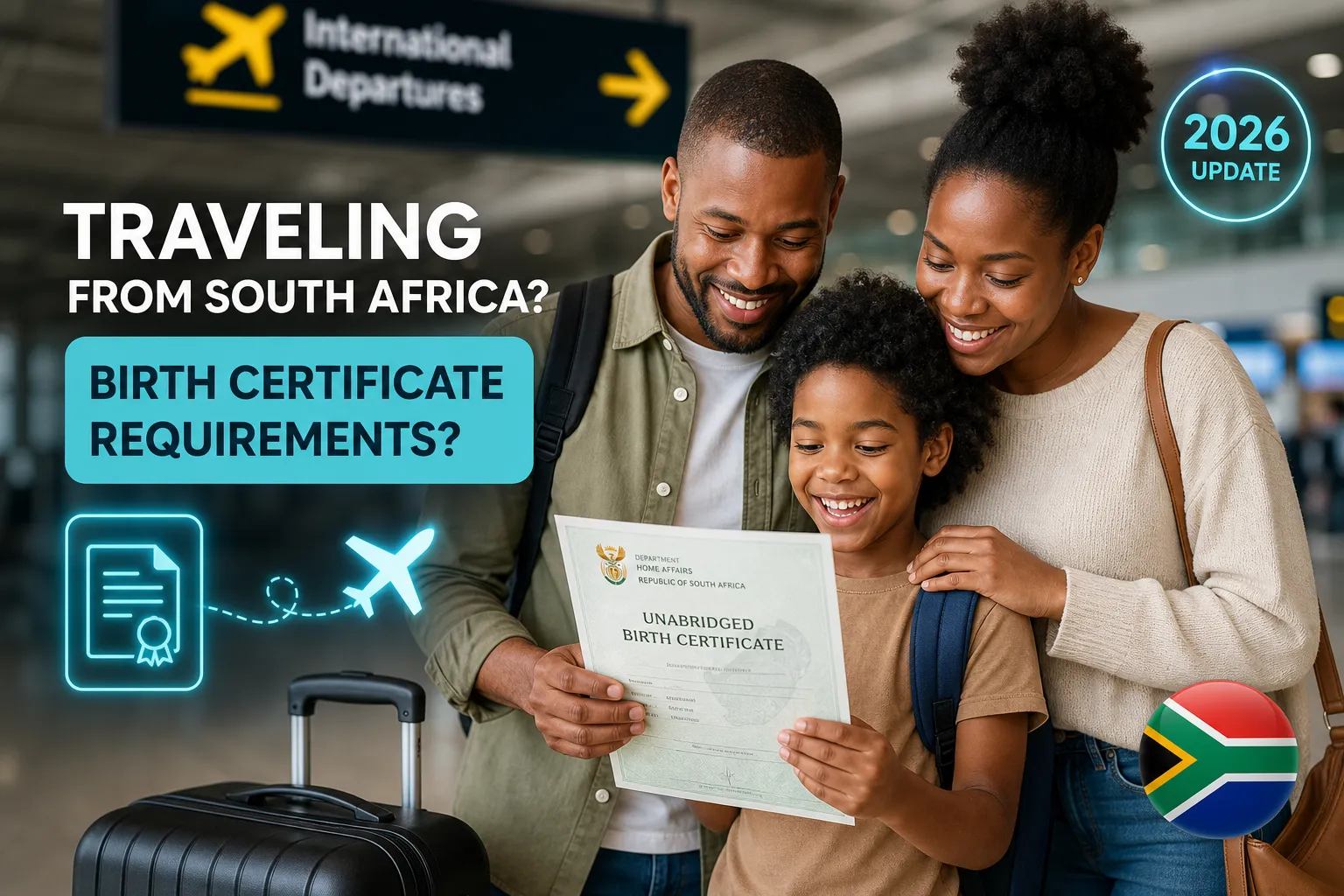
Picture this: you're at OR Tambo International Airport, your child's passport is valid, the bags are checked, and you're ready to board. Then the check-in agent asks for the birth certificate, and the one you've brought, the short version issued when your child was registered, isn't what they need. The boarding gate closes without you. It sounds extreme, but it's a scenario commonly reported by South African families, and it's still happening in 2026 because the rules around child travel documents remain widely misunderstood.
South Africa requires specific documentation for minors travelling internationally, and the unabridged birth certificate sits at the centre of those requirements. Understanding whether your child needs one, what supporting documents must accompany it, how long the process takes, and how to get the certificate authenticated for use abroad is what separates a smooth departure from a last-minute crisis. This 2026 guide to unabridged birth certificates for minor travel from South Africa covers all of it, including a practical path forward for parents who are managing the process from outside the country entirely.
2026 guide: which children need an unabridged birth certificate for minor travel
Not every child departing South Africa needs one, but the conditions that trigger the requirement are precise enough that you shouldn't assume your situation is an exception. South African minors under 18 are generally required to carry an unabridged birth certificate when leaving the country on an international flight. The operative word is generally: children travelling on a South African passport where parents' details are included may fall under a Home Affairs exemption, and children in direct airport transit may also be exempt. It is worth checking with Home Affairs or your airline ahead of travel if you believe either exemption applies to your child.
The scenarios where the certificate typically becomes non-negotiable include a child travelling with only one parent, a child travelling with a guardian or family member who is not a parent, and an unaccompanied minor. In each of these cases, the unabridged birth certificate is required alongside additional consent documentation. These are the situations most likely to result in denial of boarding if the paperwork isn't complete.
Visa-exempt foreign minors entering or leaving South Africa may also need to produce a birth certificate or equivalent parentage document. However, foreign children who already submitted a birth certificate as part of their South African visa application are generally exempt from presenting it again at the border. If you're uncertain which category your child falls into, the safest position is to have the unabridged certificate ready regardless.
Abridged vs unabridged: what the difference means at the border
The abridged birth certificate is the condensed version most parents receive at birth registration. It contains basic details such as the child's name, date of birth, and registration number, but it does not show both parents' full names, ID numbers, or nationalities. The unabridged certificate is the complete official record that lists all of that information, and that is the document border officials and airline agents are looking for.
The reason South Africa insists on the full version is straightforward: it confirms parentage. When a child is travelling with an adult, immigration authorities need to establish the legal relationship between that adult and the child. The unabridged certificate provides exactly that evidence, and it was made a travel requirement specifically as a safeguard against child trafficking. A child arriving at check-in with only the short version may be denied boarding, regardless of the accompanying adult's relationship to the child or their intentions.
Airlines check documents at the check-in desk, not only at the border, which is why the consequence of having the wrong document type is immediate. Home Affairs officials at the port of entry verify again on the other side. Presenting the abridged version and hoping it will be accepted is not a strategy worth testing when you have a flight to catch.
Your complete document checklist for the DHA-154 application
The official application form for an unabridged birth certificate is the DHA-154 (sometimes referred to as the BI-154, though confirm the current designation with Home Affairs before submitting). It must be completed in full and in black ink. Alongside the completed form, you will need a copy of your identity document or passport, a copy of the child's existing abridged birth certificate if one was issued (it helps Home Affairs trace the record), and certified copies of both parents' identity documents or passports.
Depending on your personal circumstances, Home Affairs may also require supporting documents beyond the standard set. Married parents may need to provide a marriage certificate. Divorced parents may need to submit a divorce decree. If the applicant holds dual citizenship, a foreign passport may be required. Naturalised citizens may be asked for a naturalisation certificate and proof of permanent residence. These are not unusual requests, they help Home Affairs verify the record correctly before issuing the certificate.
Consent letters and parental affidavits are not automatically part of the birth certificate application itself. They become necessary in specific travel scenarios: when one parent will be absent during the trip, when a guardian or non-parent adult is travelling with the child, or when the child is travelling unaccompanied. A parental consent affidavit must be commissioned by a commissioner of oaths or a notary public and should include the non-travelling parent's full details, the travel dates, the destination, and the name of the adult accompanying the child.
Fees and realistic processing times to plan around in 2026
According to the Home Affairs fee schedule, the standard fee for an unabridged birth certificate application or re-issue is R75. The first certificate issued at the point of birth registration is free of charge. If the birth was never registered, late birth registration is a separate and significantly longer process, with fees of R75 for children under 15 and R150 for those over 15, and a processing timeline of three to six months or more. These fees and timelines are based on publicly available Home Affairs guidance; confirm current rates directly with Home Affairs or at your nearest mission before submitting.
Standard applications where the records are digitised and accessible typically take six to eight weeks from submission to receipt. Archived or vault record searches, common for older births or records that were never digitised, can extend the timeline to eight to twelve weeks or longer. If travel is approaching and your application is already in progress but the physical certificate hasn't arrived, Home Affairs can issue an official letter confirming the application status. Depending on the port of entry and the border official's discretion, this letter may be accepted in place of the physical certificate, though this is not guaranteed, and you should not rely on it as a substitute.
The practical implication for travel planning is clear: apply as early as possible. If your child's travel date is eight weeks away and you haven't started the application, you're already cutting it close. If the record requires an archived search, you may need to rebook flights or make contingency plans. Build the processing time into your travel booking decisions before you commit to dates.
How to get the certificate apostilled or legalised for use abroad
An unabridged birth certificate issued by South African Home Affairs is a domestic document. For it to be legally recognised at a foreign embassy, in a visa application, or at an overseas border, it needs to be authenticated by the Department of International Relations and Co-operation (DIRCO). The type of authentication depends on where the document is going.
If the destination country is a signatory to the Hague Apostille Convention, DIRCO issues an apostille. If the country is not a Hague member, DIRCO issues a certificate of authentication or legalisation instead. You must confirm which applies to your destination before submitting to DIRCO, as the process differs. The DIRCO Legalisation Section at OR Tambo Building in Pretoria handles both, and documents may be submitted in person or by courier. Their enquiries email is legalisation@dirco.gov.za. Confirm current submission procedures and turnaround times directly with DIRCO, as operational details can change.
DIRCO requires the original Home Affairs-issued unabridged birth certificate. Photocopies are not accepted, and the certificate must not be damaged or laminated. Your cover letter should state the destination country clearly so DIRCO can determine the correct legalisation route. For certain document formats, or if the signing official's details cannot be verified in DIRCO's records, you may need to have the document certified by a public notary and verified by the Registrar of the High Court first. Only then will DIRCO process the apostille. Planning for this step adds time to an already lengthy process, so factor it in early.
How parents living abroad can get their child's certificate without returning to South Africa
For South African parents raising children from the United States, the United Kingdom, or elsewhere, the standard Home Affairs process presents a real barrier. Many applications require someone to physically attend a Home Affairs office or South African mission, submit original documents, and follow up in person, though the exact requirements vary by mission and country of residence. Flying back to South Africa to submit paperwork is not a practical option for a parent based in New York or Los Angeles who cannot take weeks off work or afford the airfare.
The official alternative for parents overseas is to submit through the nearest South African embassy, consulate, or mission. The DHA-154, supporting identity documents, and proof of payment are submitted through the mission's consular process, which varies by location. Some missions accept courier submissions; others require an in-person appointment. The application is then forwarded to Home Affairs in South Africa for processing, which means the six-to-eight-week timeline still applies from the point of submission, not from when you first enquire.
For parents who need the process managed end to end, a specialist document assistance service can remove much of that complexity. Authentic Documents SA manages exactly this type of process on behalf of South African parents abroad, from preparing the DHA-154 correctly and liaising with Home Affairs and DIRCO, to handling the apostille where required and delivering the authenticated certificate via secure worldwide courier. Because the service focuses exclusively on South African official documents, requirements are tracked in real time and applied to each specific case. For parents who cannot afford a rejected application or a missed deadline, having a dedicated case manager who knows the current requirements can make a significant practical difference.
What to do before you book the flights
By now you have a clear picture of what the requirements are. This 2026 guide to unabridged birth certificates for minor travel from South Africa points to one consistent theme: preparation time is the variable most within your control. South African minors under 18 travelling internationally generally need an unabridged birth certificate showing both parents' details in full. The fee is R75 for a standard application or re-issue, and the realistic processing time is six to eight weeks, with longer timelines possible for archived records. If the certificate will be used at a foreign embassy or overseas border, a DIRCO apostille or authentication is also required, using the original document.
If you are based overseas and managing this remotely, start early and use every available channel, whether that is your nearest South African mission or a specialist service that handles the full process on your behalf. The consequence of arriving at the airport without the right documents is not a minor inconvenience; it is denial of boarding, rebooking costs, and, if the trip was time-sensitive, missed appointments or visa interviews that are difficult to reschedule.
Before you finalise any travel booking, run your child's specific travel scenario against the checklist in this guide: who they are travelling with, whether the destination country requires apostille authentication, and whether your timeline allows six to eight weeks for the application to process. If there is any uncertainty about whether your child's current documents meet the requirements, resolve it before the booking is confirmed, not at the check-in counter. Download the DHA-154 from the Home Affairs website, contact your nearest South African mission, or get in touch with a specialist service to start the process today.
Why Use a Professional Assistance Service?
Many applicants prefer expert help because it can reduce delays, confusion, and repeated follow-ups.
Authentic Documents SA assists clients locally and internationally with document applications and secure courier options.
Need Help?
Authentic Documents SA assists clients locally and internationally with Unabridged Birth Certificates, courier support, and professional document guidance.
If you need assistance with an Unabridged Birth Certificate in South Africa, contact Authentic Documents SA for professional support.
Visit the Authentic Documents SA homepage for more information.