How Long Does an Unabridged Birth Certificate Take in South Africa (2026)
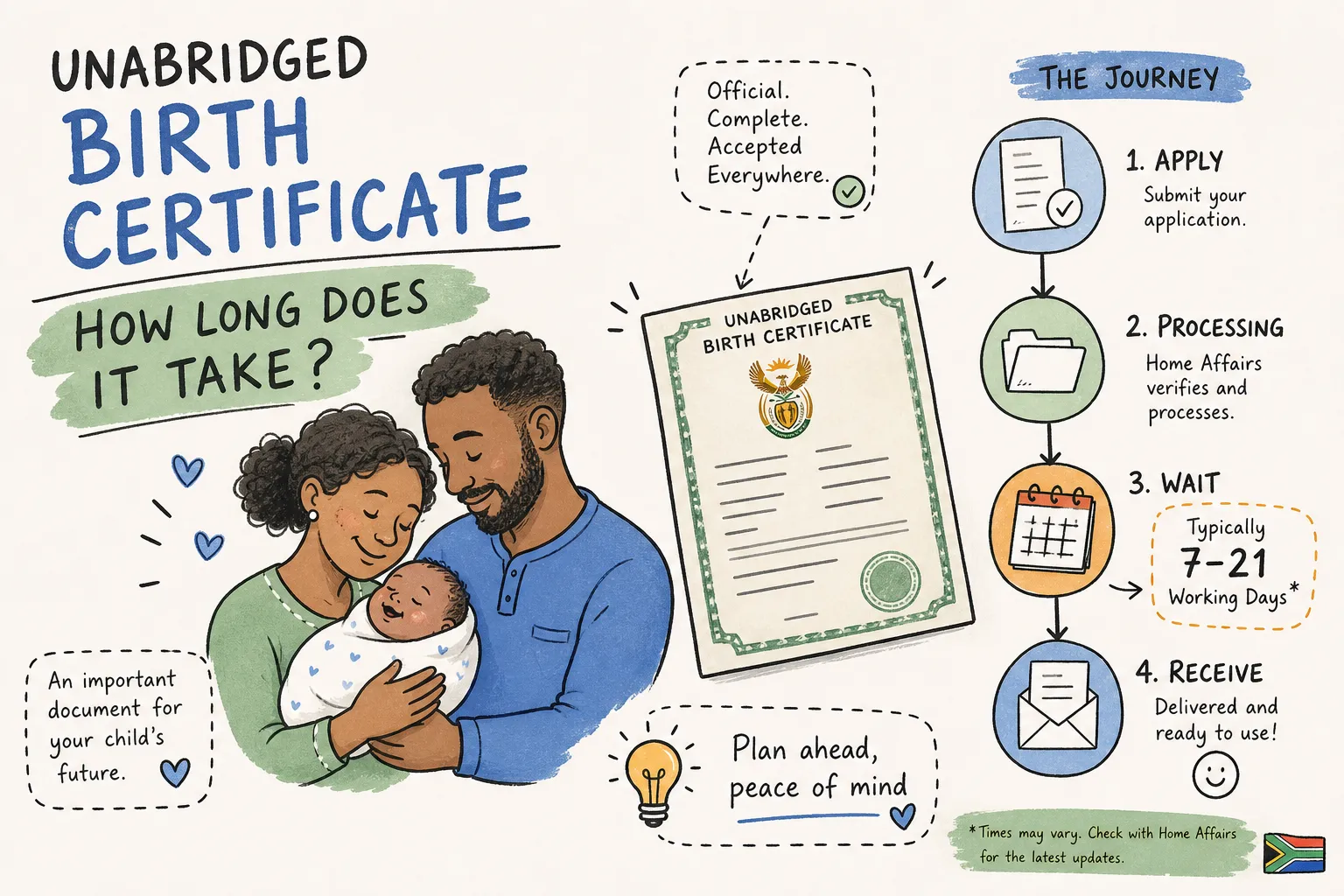
Many applicants report inconsistent answers from Home Affairs on timing. You submit your application, receive a receipt, and then wait. Weeks pass. You follow up. You get a different answer each time, or no answer at all. If you are applying from overseas, the situation is often more difficult: your communication with a South African mission typically runs through a shared inbox or mission-specific channels, and the silence can stretch for months before you know whether anything has moved.
So how long does an unabridged birth certificate take in South Africa in 2026? The honest answer is: it depends on three things, where you apply, what you submit, and whether your birth record is easy to trace. Each of those variables has a significant impact on your outcome. This 2026 guide gives you realistic timelines for each application route, the exact documents you need to avoid rejection, the most common causes of delay, and what your options are when you need this process to move faster.
This information comes from working inside these applications daily. At Authentic Documents SA, a paid facilitation service, we assist clients across the globe with unabridged birth certificate applications and follow up with Home Affairs so our clients never have to guess where they stand.
What Home Affairs officially says about processing time in 2026
The standard 6, 8 week window explained
For a standard application submitted at a Home Affairs office inside South Africa, the Department's published turnaround is approximately 6, 8 weeks from the date of complete submission. "Complete" is the key word. That window only applies when the birth is registered in the system, the record is digitised, and every supporting document matches the register exactly. The government application fee is approximately R75 (per the DHA fee schedule; fees at overseas missions may differ and may be charged in local currency), separate from any facilitation or courier costs. When those conditions are met, 6, 8 weeks is a realistic expectation.
When the timeline stretches to 3, 6 months or longer
Older registrations, particularly those from before the digitalisation of Home Affairs records, introduce a different category of delay. When the birth record must be retrieved from physical vault storage in Pretoria, the process leaves the standard workflow entirely. In these cases, 3, 6 months is the more realistic baseline. For applications submitted through a South African mission or consulate abroad, official guidance cites 6 months as a starting point, with some missions quoting up to 12 months. That is not a worst-case scenario: it is the published expectation for overseas applicants.
How your application route affects the unabridged birth certificate timeline, 2026
Applying at a DHA office inside South Africa
This is the fastest available route to get your unabridged birth certificate in 2026. A direct application at a Home Affairs office removes any intermediary handoff from the process. The 6, 8 week window applies here most reliably, provided the application is complete on the day of submission. Walking in with everything correct gives your application the best possible start in the system. Walking in with anything missing places the application on hold and restarts the processing clock.
Applying through a South African embassy or consulate abroad
Mission-specific rules vary considerably. Canberra quotes approximately 10 working days; Stockholm, around 15; Lisbon, up to 21 working days, though Lisbon explicitly suspends the clock the moment any document is outstanding. (Figures sourced from published mission guidance, check your specific mission's website for current timelines, as these are subject to change.) Some missions require in-person appointments exclusively, while others accept postal submissions. One rule holds across all missions: any gap in your document set pauses processing entirely, and the mission cannot resolve the underlying record issue on your behalf. For most overseas applicants, the realistic expectation is somewhere between 6 and 12 months.
Using a third-party facilitation service
Private services act as a submission and tracking layer between you and Home Affairs. They do not have a separate processing queue inside DHA, but they reduce the risk of an incomplete submission, which is where the majority of delays originate. In 2026, agency-quoted turnaround times from private facilitation services range from 30, 40 working days for standard routes to 2, 4 weeks on priority handling. These are agency-quoted timelines, not government guarantees. The real value is in submission accuracy and active follow-up during the processing period.
Documents to prepare before you submit
For a birth registered in South Africa
The core requirement is a completed BI-154 (DHA-154) application form, the child's existing birth certificate or notice of birth, and certified copies of both parents' South African identity documents or passports. You will also need a copy of the applicant's own ID. Some offices also request proof of address not older than three months, typically a utility bill, bank statement, or municipal rates account. If the child's name was legally changed through Home Affairs at any point, a copy of the approved amendment is required alongside the original registration details.
For replacements, re-issues and births registered abroad
Replacement applications follow the same BI-154 route but require the previous certificate if available. Where someone is applying on another person's behalf, a notarised power of attorney is also necessary. For children born abroad, the foreign birth registration document helps Home Affairs locate the South African record. Any document not in English or Afrikaans must be accompanied by a sworn translation from an accredited translator. Getting these details right before submission is what separates a 6-week outcome from a 6-month one.
Apostille and document authentication for international use
If you need your unabridged birth certificate for travel, a foreign passport application, or use in another country, you may also require an apostille or legalisation. South Africa is a signatory to the Hague Apostille Convention, meaning a South African-issued apostille (applied by the Department of International Relations and Cooperation, or DIRCO) is recognised in all member states. For non-Hague countries, embassy legalisation is required instead. It is worth confirming with the receiving country's embassy or authority which certification is needed before you apply, so you can arrange both the certificate and its authentication in a single process rather than two separate steps.
Why applications stall and how to keep yours moving
The most common rejection triggers
Mismatched names between the application form and the birth register cause a disproportionate number of rejections. This happens when applicants use a known family name that differs from the registered surname, or when initials appear on the form where full given names are required. An incomplete BI-154, a missing parent's ID copy, or a form completed in the wrong ink colour where a specific colour is required by that office are small errors with large consequences. The application is returned, and the clock resets entirely.
Information inconsistencies between documents are another frequent problem. If the spelling of a name varies across the identity document, the birth registration, and the application form, Home Affairs will query it. That query adds weeks. Checking every document against every other document before you submit is not optional. It is the single most effective thing you can do to protect your timeline.
The archived-record problem and what to do about it
Registrations from the 1970s through the early 1990s may not be fully digitised. When Home Affairs must retrieve the physical record from vault storage, the application moves outside the standard digital workflow. There is no tracking reference that updates in real time for these cases, a limitation that follows from the manual nature of the vault-retrieval process. The practical response is to submit as early as possible, retain copies of every document you submit, and have someone who can follow up directly with the relevant Home Affairs office in Pretoria once the standard window has passed.
Paid expedited options and what they realistically offer
What private services actually provide
The Department of Home Affairs does not operate an official express lane for unabridged birth certificate applications. Private facilitation services offer faster submission preparation, reduced rejection risk on first submission, and active follow-up during processing. In 2026, costs quoted by South African facilitation agencies range from approximately R1,200 for standard facilitation with a 30, 40 working day target to R2,950, R4,650 for priority handling aimed at a 3, 6 week outcome. These figures reflect agency-quoted turnarounds rather than government commitments, and pricing can change, confirm current rates directly with the service provider.
What you are paying for
The value in a paid service is not a shortcut through the DHA queue. It is the reduction in back-and-forth. A correct, complete application submitted with follow-up capability will almost always move faster than a self-submitted application with a single missing page. For clients abroad, the additional value is having someone physically able to engage with Home Affairs offices in South Africa when a query arises. You are not buying speed inside the DHA system; you are buying the preparation and persistence that keeps your application from stalling outside it.
When handing this over to a specialist is the smarter move
The case for professional assistance when you are overseas
Applying from outside South Africa creates a structural disadvantage. You cannot walk in to resolve a query. You cannot verify your application's status in person. Your communication with a South African mission is often through a shared inbox with a multi-week response window. The DHA's online tracking portal is currently suspended, meaning phone follow-up becomes the primary option. That is only practical for applicants who can reach the DHA call centre queue on 0800 60 11 90 during South African business hours, a meaningful barrier for those in distant time zones. The risk is not just delay: it is that your application sits incomplete for months while you have no visibility into why.
How Authentic Documents SA manages the process end to end
This is the gap that Authentic Documents SA was built to close. Rather than leaving you to track a silent Home Affairs queue from abroad, our team monitors your application, follows up with Home Affairs on your behalf when the timeline extends, and flags any outstanding requirements before they become a rejection. We handle the BI-154 preparation, document verification, and submission through the correct channel for your specific situation. Once your unabridged birth certificate is issued, we aim to deliver it directly to you anywhere in the world via secure, tracked courier. You always know where your application stands, because someone with direct access to the process is tracking it on your behalf.
How long does an unabridged birth certificate take in South Africa, summary (2026)
A standard unabridged birth certificate application in South Africa takes 6, 8 weeks at a DHA office when the submission is complete and the birth record is accessible in the system. Archived records push that to 3, 6 months. Applications processed through overseas missions sit in the 6, 12 month range. The timeline is largely within your control: the right documents, submitted correctly the first time, are the single biggest factor in how fast you receive your certificate.
For anyone applying from abroad, the process carries real risk of invisible delay. Authentic Documents SA removes that uncertainty by managing submissions, following up with Home Affairs, and delivering completed documents worldwide. If you are still asking how long this will take in 2026, the honest answer is: it depends on how well your application is prepared. Working with people who do this every day is the most reliable way to shorten that answer.
If you are ready to get started or want a clear picture of what your specific application involves, contact Authentic Documents SA for a straightforward assessment. No guesswork, no silent queues, and no surprises. You can also check the Department of Home Affairs website for official guidance and current fee schedules.
Why Use a Professional Assistance Service?
Many applicants prefer expert help because it can reduce delays, confusion, and repeated follow-ups.
Authentic Documents SA assists clients locally and internationally with document applications and secure courier options.
Many applicants needing documents for immigration, travel, and international applications prefer professional guidance and courier support.
Need Help?
If you need assistance with an Unabridged Birth Certificate in South Africa, contact Authentic Documents SA for professional support.